




Join our newsletter to receive meaningful updates, expert insights, and resources tailored to your interests. We promise to keep our communication valuable - never overwhelming.
Going Hybrid and Zero-Trust: Uniting the Sector at Critical Communications World 2026
Around: 6 min. read
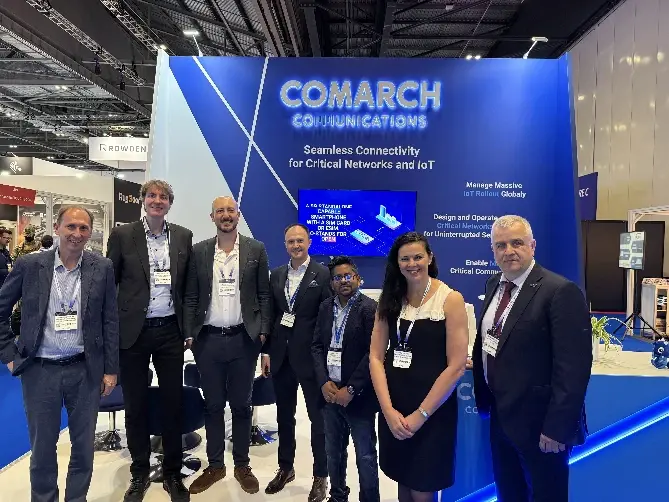
Critical Communications World 2026 at ExCeL London brought together public safety agencies, railway operators, utilities, regulators, and industry leaders like Motorola, Nokia, Ericsson, and Comarch Communications under TCCA’s theme "Uniting the Sector - Working Together to Enhance the Ecosystem".
Discussions focused on transitioning legacy TETRA networks to 5G MCx while keeping reliable voice as top priority, alongside advancing Edge AI, early 6G, and Non-Terrestrial Networks. Crucially, experts addressed Zero-Trust cybersecurity for open 5G environments and the urgent need for dedicated 400/450 MHz spectrum to secure Smart Grids against power blackouts.
Key Trends in Critical Communications
The critical communications industry is transitioning from voice-centric systems toward data and multimedia-rich networks supporting streaming video, telemetry, and smart applications. However, experts agree that hybrid models will dominate, with narrowband TETRA/LMR networks co-existing alongside broadband 4G/5G networks for over a decade. A strong trend is the emergence of commercial MNO partnerships, where public safety agencies leverage commercial infrastructure via advanced QoS prioritization, 5G network slicing, or Full MVNO models rather than building greenfield networks from scratch - a strategy reinforced by Analysys Mason’s Charles Murray, who demonstrated that new multimedia capabilities must be deployed while preserving absolute priority for uninterrupted Mission Critical Voice.
Key Aspects of LMR and TETRA Migration
Broadband migration follows an "extend, don't replace" philosophy. First-responder agencies rely on TETRA as a primary fallback while 3GPP LTE/5G MCx (MCPTT, MCVideo, MCData) capabilities undergo operational validation. Essential migration requirements include Interworking Function (IWF) gateways for cross-technology talkgroup communication, dual-mode handheld devices, and complex MNO network modifications. Transitioning to commercial LTE requires mass adjustment of Allocation and Retention Priority (ARP) parameters and specialized SIM access classes to ensure mission-critical traffic pre-empts consumer data. Handheld smartphones must also meet rugged criteria, featuring physical PTT buttons, high-decibel audio, and extreme environmental resistance - a real-world implementation showcased by Comarch Communications’ Rafał Markiewicz and Sławomir Nowak, who presented how Belgian public safety operator ASTRID deployed Comarch Communications Smart BSS to modernize billing and service management, achieving zero-failure reliability across 4G/5G MCx and hybrid networks.
Critical Networks for Energy Utilities and Railway Infrastructure
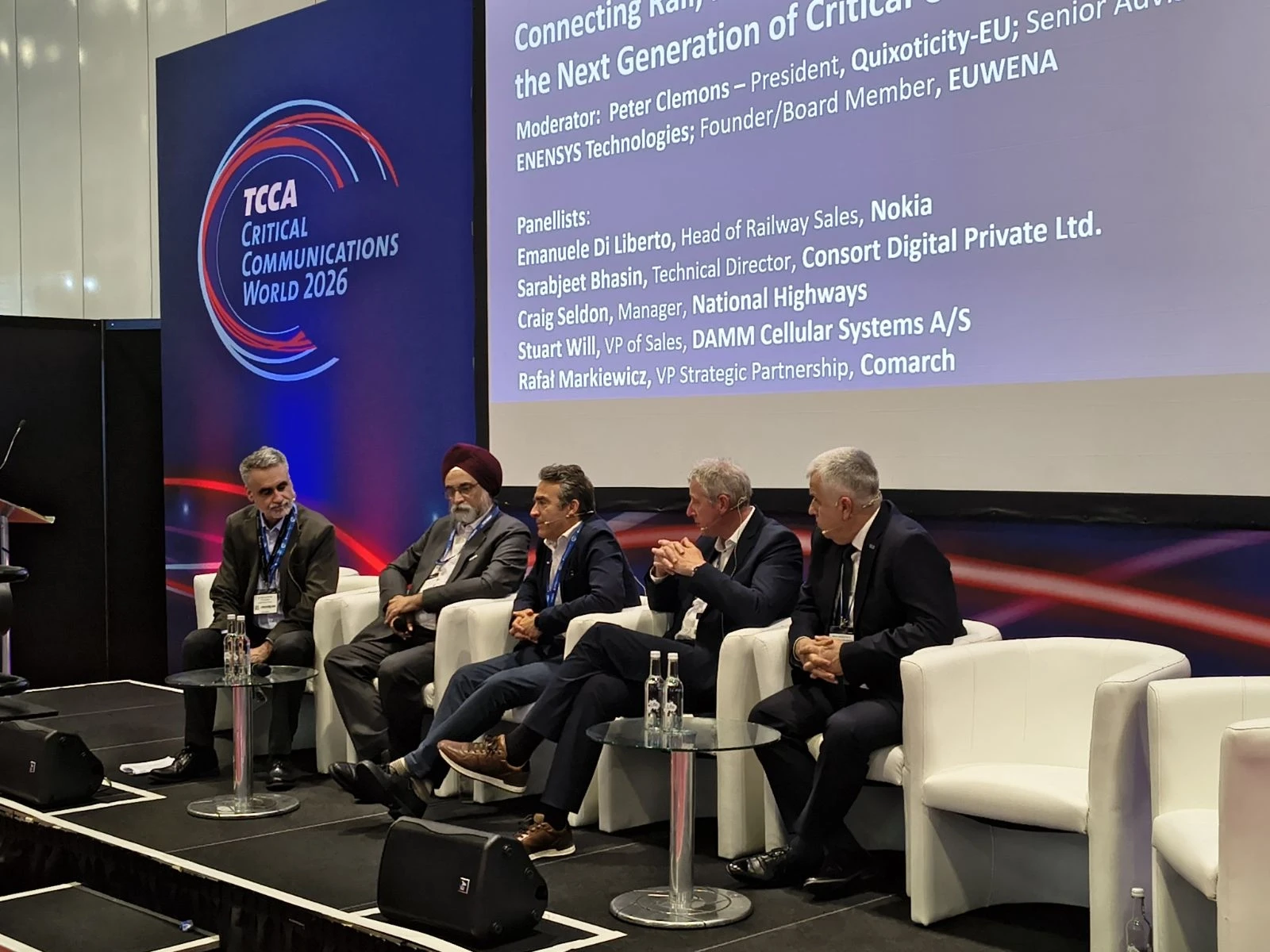
Critical infrastructure networks are migrating away from isolated Operational Technology (OT) islands toward unified private or shared 5G/LTE networks. In the railway sector, operators are executing a historic transition from legacy GSM-R to FRMCS (Future Railway Mobile Communication System) based on 5G Standalone architecture and 3GPP MCx. Operating primarily in dedicated n100 (900 MHz) and n101 (1900 MHz) bands, mass commercial FRMCS rollout is projected between 2028 and 20301.
In energy and utilities, major blackouts like the 2025 Iberian outage demonstrated that dedicated telecom resilience is essential for black-start grid recovery. Organizations such as the EUTC warn that operating modern Smart Grids requires dedicated spectrum bandwidths of at least 2x5 MHz (around 400 MHz / 450 MHz) to achieve Net Zero 2050 climate targets. Furthermore, moving to open broadband exposes SCADA systems, PLCs, and metering infrastructure to cyber threats (such as Volt Typhoon), requiring Zero Trust security and compliance with NIS2 and IEC 62443 standards.
Artificial Intelligence and Edge Intelligence Use Cases
Artificial Intelligence is vital where split-second decisions are required. Edge AI moves video analytics and LLMs directly to vehicle gateways, drones, and body-worn devices, ensuring intelligence remains operational even if backhaul cloud connectivity is lost. AI consolidates massive video and IoT streams into a Common Operating Picture (COP), transforming raw data into actionable alerts for dispatchers. Additionally, AI is transforming cybersecurity defense - during the GSMA Keynote, Shohel Ahmed addressed OT threat landscapes, advocating AI-driven cybersecurity, Zero Trust segmentation to stop lateral movement, and post-quantum preparedness. AI is also enabling niche operational tools, such as Spoofed Call Detectors.

Mass Industrial IoT, Ambient IoT, and Evolving 6G Standards
Broadband adoption is expanding critical infrastructure IoT from basic telemetry to Massive IoT ecosystems supporting millions of real-time devices. In railways, M2M sensors enable Automated Train Operation (ATO), station CCTV, and predictive maintenance. In utilities, IoT powers Distributed Energy Resources (DER), SCADA, synchrophasors, and dynamic load assessment. Fusing 5G IoT with Edge Computing processes sensor streams locally without overloading central clouds.
Looking ahead to 6G, standardization is focusing on Ambient IoT - a new class of battery-free, ultra-low-power sensors positioned below NB-IoT and LTE-M. Operating on narrow half-duplex channels, Ambient IoT will be natively supported across terrestrial and satellite (NTN) networks to monitor pipelines and track beds without battery replacements. Furthermore, Integrated Sensing and Communication (ISAC) will transform radio waves into radar-like sensors scanning physical environments for track anomalies.
Bridging Telecom and IT: The Critical Role of OSS/BSS in MCx Networks
Deploying broadband MCx and industrial IoT requires an equally capable, secure, and scalable IT backend. As showcased by Comarch Communications at CCW 2026, the physical characteristics of critical networks: zero-failure reliability, resilience, and security—must be mirrored directly in BSS (Business Support Systems) and OSS (Operations Support Systems) architectures.
To deliver operational sovereignty without vendor lock-in, Comarch Communications’ Umbrella NMS acts as a single-pane-of-glass orchestration engine across multi-vendor LTE/5G, private spectrum (e.g., 450 MHz), fixed, and satellite (NTN) networks. Key functional and architectural capabilities required for next-generation critical networks include:
- Mission-Critical MCx Orchestration & QoS Management: The platform provides zero-touch provisioning and real-time charging for 3GPP MCx services (MCPTT, MCVideo, MCData). Its automated QCI/QoS management dynamically enforces policy prioritization across network cores, guaranteeing high-priority voice and SCADA channels during severe network congestion.
- Zero Trust Security, Anchoring, and Device Control: Built on geographically distributed active-active architectures, the platform ensures instant failover between primary and backup dispatch centers. Aligned with "Secure by Design" principles, the platform integrates continuous SIEM/SOC analytics with hardware-SIM anchoring (IMEI mismatch prevention), geofencing, and inactivity monitoring.
- Massive IoT and Full eSIM Lifecycle Management: Field-tested on over 65 million SIMs, the high-velocity usage store streams over a billion session events daily. It supports full lifecycle automation for physical SIMs and eSIMs aligned with GSMA specifications (M2M SGP.02, Consumer SGP.22, and IoT SGP.32), supporting zero-touch field provisioning and bulk profile swaps.
- Monetization, Convergent Charging, and Hierarchical Split-Billing: The advanced 5G Charging Function handles granular tariffing by rating group, DNN, and QoS profile. To support complex public safety and utility structures, the BSS layer provides multi-tenant enterprise portals with hierarchical split-billing—allowing cost allocation between central state budgets, regional dispatch units, and third-party contractors.
Learn more about Comarch Communications NMS, CMP, and BSS/OSS solutions.
Sources:
Di Liberto, E., From Rail to Rescue: Lessons in convergence from FRMCS to MCX, Nokia, June 17, 2026

7 min. read
Space ODA: Integrating SatCom into the Terrestrial 5G/6G Ecosystem
4 min. read
Building the Foundation for AI-Native Networks: How Telecom Operators Can Prepare for 6G?
7 min. read
Going Techco: AI-Native Architecture, Digital Twins, and the End of the Monolith Era at DTW Ignite 2026
8 min. read
The EU AI Act: A Practical Guide to Compliance for Business and Technology Leaders
5 min. read
Insights from Comarch Communications’ First IoT Connectivity Forum: AI, Massive SIM Rollouts, and New GSMA Standards
9 min. read
Comarch User Group 2026: Together Towards The AI-Driven Future of Connectivity
5 min. read
The Surge of eSIM, iSIM, and RedCap Device Deployments in IoT ApplicationsSign up for more insightful content