






Join our newsletter to receive meaningful updates, expert insights, and resources tailored to your interests. We promise to keep our communication valuable - never overwhelming.
Why Critical Infrastructure Is Moving to Dedicated Mobile Networks
Around: 3 min. read

Power lines, pipelines, railway corridors and emergency services have one thing in common: they can’t rely on best-effort connectivity. Yet many still depend on public networks or legacy narrowband systems that were never designed for today’s operational demands. That’s why operators across Energy, Utilities, Oil & Gas, Railways and Public Safety are turning to dedicated mobile networks built on 3GPP standards and operating on reserved spectrum.
Resilience and control
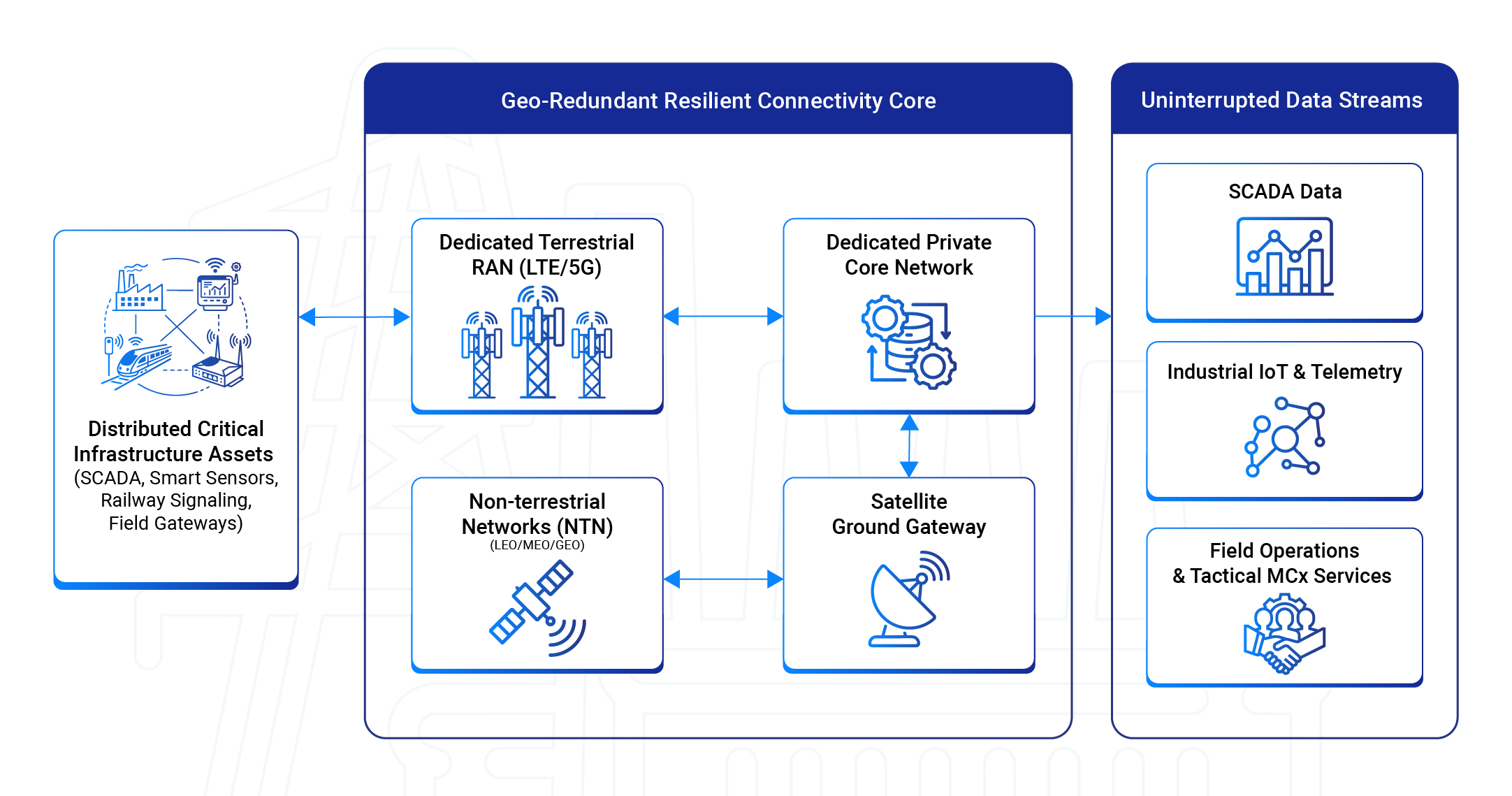
A dedicated network isolates critical traffic from commercial congestion and removes single points of failure. This matters most during storms and other emergencies, when public networks are overloaded and field crews need reliable connectivity the most. For the most remote assets, the network can be backed up by satellite (NTN) links. The diagram below shows how this hybrid model works: distributed assets connect through both a dedicated terrestrial RAN and satellite networks, while a private core keeps SCADA data, IoT telemetry and field communications flowing without interruption.
A dedicated network also gives operators full control over SLAs and technology lifecycles, without forced 2G/3G sunsets imposed by commercial operators. Regulators increasingly support this approach by reserving spectrum for critical infrastructure, such as the 410/450 MHz bands for utilities in Europe and dedicated FRMCS bands for railways.
New capabilities and better coverage
3GPP standards open the way to massive IoT for smart grids, mission-critical broadband (MCx) for public safety and FRMCS for railways, replacing systems such as TETRA and GSM-R. Sub-GHz bands such as 410/450 MHz cover vast regions with 70–80% fewer base stations than traditional public networks and reach deep indoor and underground locations.
Lower costs
Wireless connectivity avoids costly trenching for fiber, eliminates recurring SIM fees for millions of devices and reduces dependence on proprietary hardware. In transport, a single network can even be divided into isolated slices: critical ones for train control and signaling, others offered commercially, for example to logistics operators at cargo terminals. On top of that, 410/450 MHz networks need far fewer sites, which lowers both CapEx and OpEx across the entire lifecycle.
Unified management
A dedicated network delivers its full value only if it doesn’t become another isolated silo. A hardware-agnostic OSS/BSS/CMP layer brings multi-vendor RAN, MCx platforms, legacy systems and OT endpoints together into one view across IT, OT and telecom. With AI/ML-based root cause analysis, operators can quickly see whether an outage comes from a radio fault, a cut fiber line or a power failure.
Our white paper “6 Reasons Distributed Critical Infrastructure Demands Dedicated Mobile Networks” explores each of these areas in more detail, with sector-specific examples and architecture overviews.


7 min. read
Space ODA: Integrating SatCom into the Terrestrial 5G/6G Ecosystem
6 min. read
Going Hybrid and Zero-Trust: Uniting the Sector at Critical Communications World 2026
4 min. read
Building the Foundation for AI-Native Networks: How Telecom Operators Can Prepare for 6G?
7 min. read
Going Techco: AI-Native Architecture, Digital Twins, and the End of the Monolith Era at DTW Ignite 2026
8 min. read
The EU AI Act: A Practical Guide to Compliance for Business and Technology Leaders
5 min. read
Insights from Comarch Communications’ First IoT Connectivity Forum: AI, Massive SIM Rollouts, and New GSMA Standards
9 min. read
Comarch User Group 2026: Together Towards the AI-Driven Future of ConnectivitySign up for more insightful content