We deliver sovereign, mission-critical BSS/OSS and orchestration solutions for public safety, seamlessly bridging narrowband networks to 3GPP broadband to ensure real-time control for first responders.

Intelligent BSS/OSS Control for Future Public Safety Networks
Public safety networks are rapidly evolving beyond traditional voice-centric communications. As PPDR agencies & public safety authorities move away from narrowband TETRA/PMR systems toward 4G and 5G MCx broadband, frontline operations are gaining access to real-time data streaming, video feeds, and integrated crisis response tools. This shift gives emergency services the digital resilience required for quicker decision-making, better situational awareness, and long-term capability growth.
Comarch Communications provides the end-to-end software brain that powers critical communications across broadband and hybrid networks. Our solutions unify Business Support Systems (BSS), Connectivity Management Platforms (CMP), and Operations Support Systems (OSS) into a single, cohesive management framework designed specifically for government agencies and PPDR operators. Designed to guarantee operational resilience and strategic sovereignty, our solutions deliver:

Gradual transition from narrowband PMR/TETRA to broadband networks without operational downtime, giving authorities complete control over the migration process.
Full data sovereignty with non-repudiable audit logs and direct event integration with national SOCs.
Predictive maintenance and proactive managed operations that eliminate single points of failure during major crises.
Engineered for Mission-Critical Operations

Automated provisioning across LTE/5G Cores, SM-DP+ eSIM platforms, MDM/EMM security suites, and MCx Application Servers backed by mandatory positive execution confirmations and automated transactional rollbacks.
Instantaneous per-SIM session authorization, anomaly detection, and policy enforcement over Diameter/N40 interfaces without dropping active emergency calls.
Subscription management of specialized QCI/5QI profiles and Allocation and Retention Priority (ARP) to guarantee emergency traffic preemption during severe network congestion.
Hierarchical account modeling (Ministry to local precinct), dynamic stock SIM management, multi-tenant agency self-care portals, and flexible split billing integrated with national ERPs.
Mission-Critical Ecosystem Architecture
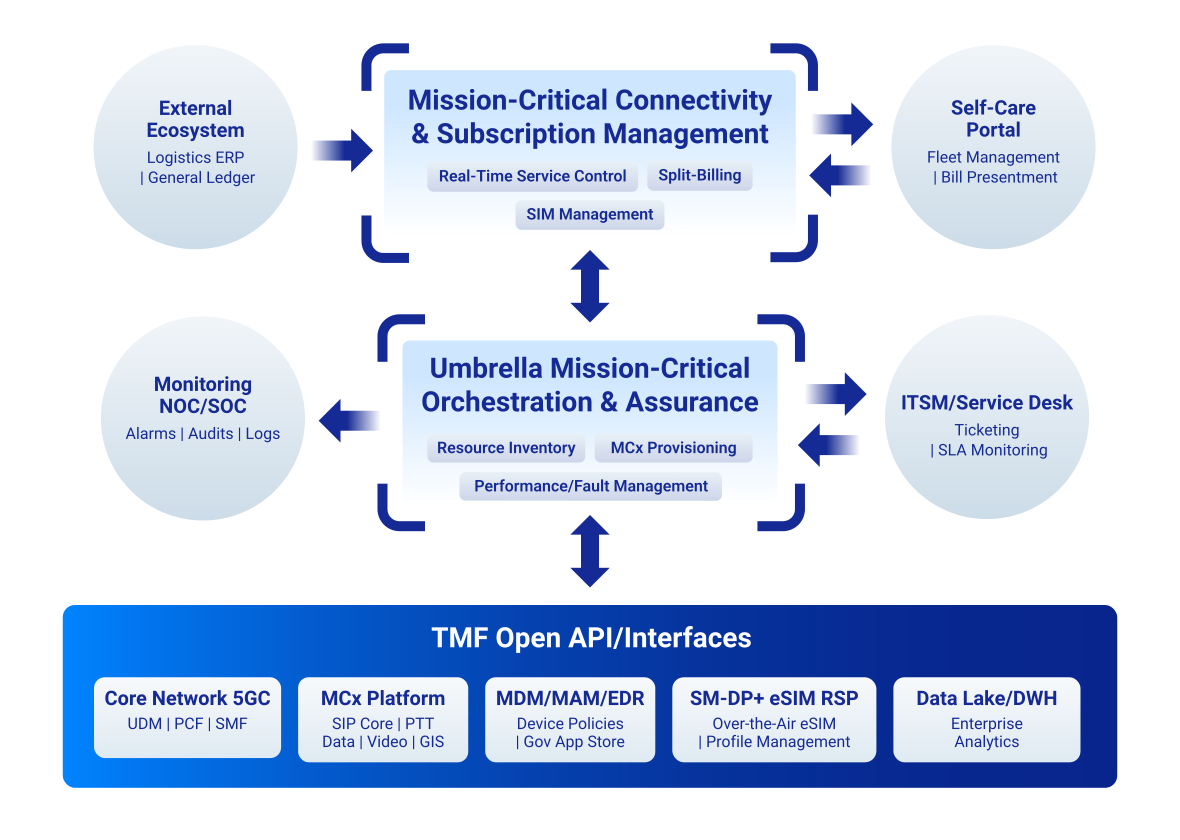
Explore Our Mission-Critical Solutions

Umbrella Mission-Critical Orchestration & Assurance
A comprehensive operations platform designed to automate zero-touch multi-domain orchestration, unify hybrid narrowband and 3GPP inventory, and provide SLA monitoring and fault management for mission-critical services (MCx) across public safety networks.

Mission-Critical Connectivity & Service Management
A unified business support platform designed to automate the full MCx subscription lifecycle, enable zero-touch service fulfillment, deliver real-time session control, and unify resource inventory across public safety networks and complex governmental structures.
Why Choose Comarch Communications for Public Safety

Public Safety: Key Questions and Answers
Key enablers of mission-critical communications (MCx) are standardized technical specifications defined by 3GPP that guarantee interoperability, security, and deterministic performance across public safety networks.
The core 3GPP specifications enabling MCx (MCPTT, MCVideo, MCData) include:
TS 23.280 (Common Functional Architecture): Establishes the unified architectural framework for all MCx services, standardizing user identities, group management, configuration profiles, and cross-agency policy enforcement.
TS 33.180 (Security Architecture for MC Services): Defines end-to-end encryption (E2EE), mutual authentication, multi-factor identity verification, and key management frameworks required for government digital sovereignty and NIS2 compliance.
TS 23.289 (MC Services over 5G System): Details the integration and migration of mission-critical services into 5G Standalone (5GS) networks, leveraging Network Slicing (S-NSSAI) and 5QI priority handling.
Comarch Communications’ solutions natively complies with these 3GPP standards to deliver zero-touch orchestration, automated policy control, and secure multi-tenant fleet management for emergency services.
The market is driven by the shift from legacy PMR to 3GPP broadband, real-time high-definition video streaming, IoT integration, and heightened demands for digital sovereignty. Modern public safety networks require flexible BSS/OSS platforms to orchestrate these hybrid capabilities seamlessly.
Explore Comarch Communications' key market insights and takeaways from Critical Communications World 2026: Uniting the Sector at CCW 2026.
Yes. Comarch Communications systems act as a unified management layer, seamlessly bridging legacy PMR/TETRA networks with 3GPP 4G/5G broadband. Through native integration with Interworking Functions (IWF), the platform enables automated dual-provisioning across LTE/5G Cores and legacy registries via a single workflow. It correlates cross-network alarms, KPIs, and usage CDRs into a unified umbrella dashboard, ensuring smooth operational continuity throughout technology transitions.
Yes. Comarch Communications systems are fully agnostic to the underlying radio and core deployment models. Whether an agency operates a dedicated state-owned network, a hybrid Multi-Operator Core Network (MOCN) sharing commercial infrastructure, or localized Private 5G slices, our software seamlessly manages subscriptions, orchestration, and SLA assurance across all topologies.
No. Built natively on 3GPP standards and TM Forum Open APIs, Comarch Communications integrates seamlessly with existing multi-vendor environments, including 5G Cores, SM-DP+ eSIM platforms, MDM security suites, and MCx Application Servers. This open architecture protects legacy investments and completely eliminates single-vendor lock-in.
Comarch Communications supports flexible deployment within sovereign national enclaves, state-certified clouds, or air-gapped on-premise environments. To fulfill strict NIS2 compliance, the platform produces cryptographically signed, immutable audit logs ensuring complete non-repudiation for all administrative actions. Furthermore, it integrates natively via Open APIs with national SOC and SIEM systems to enable real-time security event telemetry and threat isolation.
Yes. Built on a multi-tenant architecture, the platform enables the creation of a unified National Safety Cloud. Beyond traditional blue-light agencies (police, fire, EMS), governments can onboard broader critical national infrastructure operators, including public transport authorities, railway operators (via FRMCS), and power utilities (over 450 MHz networks), onto a single, securely partitioned management framework.
In mission-critical public safety infrastructure, OSS, BSS, and CMP platforms integrate across core networks, security layers, and enterprise IT to automate zero-touch operations.
- Network Core & eSIM Provisioning: Automated dispatch of profiles, QoS parameters, and DNNs to 5GC registries (UDM/PCF/SMF) and GSMA SM-DP+ servers for OTA eSIM management.
- Real-Time Control & Security Monitoring: OCS/CHF integration for sub-second session control, streaming CDRs, and real-time security alerts (e.g., IMEI mismatch) to NOC/SOC centers.
- MDM & MCx Application Management: Automated provisioning triggers to MDM/MAM systems for device security policies and MCx platform tenant configurations.
- Enterprise ERP, Data Lake & Notifications: Open APIs connecting supplier logistics/ERP platforms, scheduled exports to corporate Data Lakes, and automated SMS/email incident alerting.
Platforms like Comarch Communications BSS/CMP & OSS implement these integrations via standard TM Forum Open APIs and 3GPP interfaces to deliver secure orchestration for PPDR agencies.

Optimize and scale your business with our experts
Share your technical or business challenges with us. Drop a line to discuss your requirements, and we will guide you through. We will show you how our technology can be applied to your company’s individual needs.