A unified business support platform designed to automate the full mission-critical services (MCx) subscription lifecycle, enable zero-touch service fulfillment, deliver real-time session control, and unify resource inventory across public safety networks and complex governmental structures.
Addressing the Primary Public Safety Challenges
Operational Challenges
Comarch Communications' Solution
Fragmented and manual provisioning of MCx services creates critical activation delays and errors, putting frontline emergency response at risk.
Delivers automated, end-to-end lifecycle management and zero-touch fulfillment for 3GPP MCx subscriptions across user equipments and IoT devices.
Disjointed tracking of network identities and hardware assets leaves agencies vulnerable to unauthorized access, SIM-swapping attacks, and compliance failures.
Provides a centralized inventory repository linking network, hardware, and routing identifiers into a single, immutable source of truth.
Lack of real-time session visibility risks undetected network anomalies, unauthorized data usage, and critical communication disruptions.
Deploys a real-time Service Control Module (SCM) to deliver instant session authorization, live usage analysis, and automated NOC alerts.
Managing multi-level agency hierarchies and high-volume tactical assets leads to heavy administrative overhead and uncontrolled data costs.
Combines multi-level hierarchy modeling with automated fleet self-care to remove back-office bottlenecks and ensure total cost control.
Rigid billing systems cannot support complex public safety funding, causing financial friction during emergencies and when splitting costs across agency tiers.
Provides a government-grade billing engine that automates disaster zero-rating, multi-tiered split billing, and ERP integration via open APIs.
Designed for Public Protection and Disaster Relief (PPDR) operators, and MNOs providing sovereign government services
Our systems leverage multi-tenancy and zero-touch orchestration to manage, provision, and bill critical connectivity across all end-user domains:
Blue-Light Services
Police, Fire & Rescue, Emergency Medical Services (EMS)
National Security & State Agencies
Border Guard, Disaster Management, Civil Protection
Critical Infrastructure
Railways (FRMCS), Power Utilities, and Transport Authorities
Core Pillars of Comarch Communications' Platform
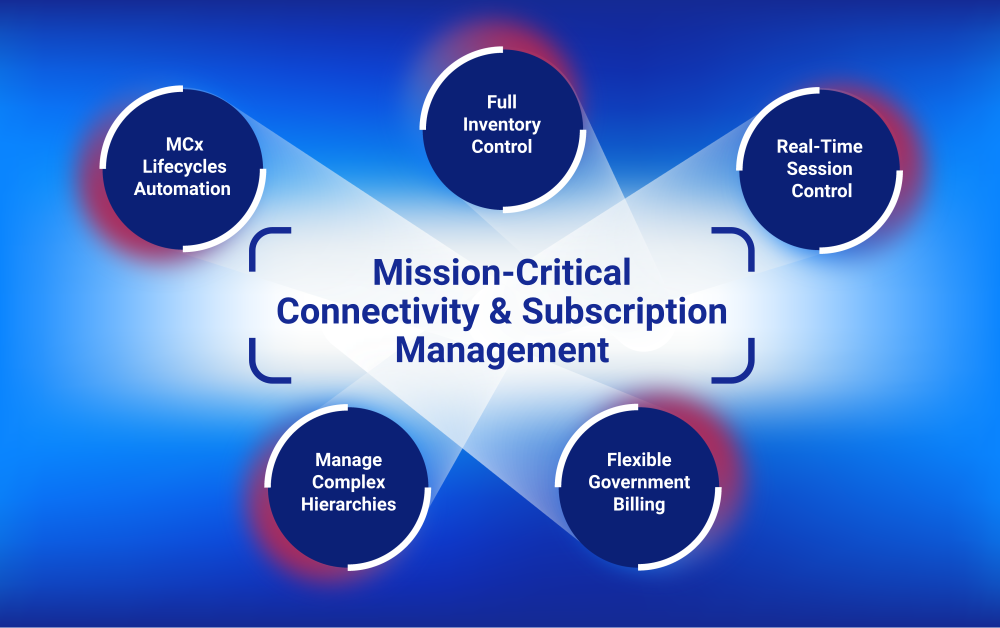
Automate MCx Lifecycles & Guarantee Priority
Secure Critical Bandwidth via 3GPP QoS: Enforce absolute voice and video priority for responders with dedicated QCI/5QI profiles (65, 67, 69/70) and ARP pre-emption control.
Eliminate Risk with Zero-Touch Provisioning: Automate error-free activation across core networks (HSS/UDM), eSIM, EMM (MDM/MAM), and MCx servers backed by strict ACK validation.
Ensure Crisis Readiness with Stock SIM Pools: Instantly activate local reserves of inactive SIMs/eSIMs en masse during critical incidents.
Gain Full Inventory Control
Maintain a Single Source of Truth: Unify network identifiers (ICCID, IMSI, MSISDN, EID), IP/Slice assets, and field hardware within one central inventory repository.
Stop Unauthorized Access with IMEI-IMSI Binding: Instantly detect SIM swaps to rogue devices ("Alien Devices") and trigger automated, real-time endpoint isolation.
Ensure NIS2 Compliance via Immutable Audit Logs: Track all subscription and configuration changes with cryptographically secured logging to guarantee full digital sovereignty.
Enforce Real-Time Session Control
Authorize and Control Sessions in Real Time: Integrate directly with SMF/PGW controllers via N40/Diameter (OCS/CHF) for instant session authorization and policy enforcement.
Detect Anomaly Risks Without Call Interruption: Stream and inspect CDRs/xDRs in real time to flag unauthorized data usage and location jumps without disrupting active calls.
Automate Incident Response via ITSM: Instantly notify NOC teams and generate Service Desk tickets (SMS/Email) as soon as operational monitoring thresholds are breached.
Empower Fleet Managers Across Complex Hierarchies
Mirror Complex State Structures Securely: Model administrative hierarchies from ministries down to local precincts with strict data isolation and fine-grained Role-Based Access Control (RBAC).
Empower Fleet Managers with Bulk Self-Care: Grant agencies full autonomy to execute mass orders, profile modifications, and SIM swaps across hundreds of tactical devices overnight.
Eliminate Video and IoT Bill Shock: Pool data transfer for bodycams, drones, and telemetry sensors into managed logical groups with dynamic usage controls and threshold alerts.
Enable Flexible Government Billing and Monetization
Apply Instant Zero-Rating During Crises: Automatically zero-rate critical group voice calls during emergencies while maintaining pro-rata billing for standard secondary traffic.
Automate Split Billing Across Agency Tiers: Route base subscription charges to central ministries while seamlessly invoicing regional units for extra add-on services on a unified bill.
Streamline ERP Integration via Open APIs: Automate the export of financial data and mediation logs directly into state ERP platforms using standard TM Forum Open APIs.
Why Choose Comarch Communications for Mission-Critical Subscription & Connectivity Management




MCx Connectivity & Management: Key Questions and Answers
In public safety networks, Business Support Systems (BSS) and Connectivity Management Platforms (CMP) act as the central operational hub managing back-office processes, subscriber lifecycles, and network policies. Key BSS/CMP functions for public safety include:
Multi-Tenant Government Hierarchies: Multi-tier account modeling that directly mirrors state agency organizational structures (e.g., Ministry, National Police, Regional Precincts) with strict Role-Based Access Control (RBAC).
End-to-End MCx Subscription Management: Full lifecycle orchestration, advanced 3GPP/5G QoS and priority profile configuration, and verified zero-touch provisioning across hybrid networks.
Real-Time Session & Policy Control: Integrated Charging Function (CHF) modules enabling instant session authorization for mission-critical (MCx) services and real-time policy enforcement over core networks.
Comarch Communications BSS/CMP delivers these capabilities within a standardized, 3GPP-compliant framework engineered specifically for PPDR operators and mission-critical service management.
The platform enforces strict IMEI-IMSI hardware binding at the network level. If a mission-critical SIM or eSIM is inserted into an unauthorized civilian device, Comarch Communications’ Service Control Module (SCM) instantly detects the hardware mismatch, issues an alert to the SOC, and automatically quarantines the subscription within the network core to prevent unauthorized access.
Yes. As part of automated subscription management, Comarch Communications’ Connectivity CMP/BSS automatically provisions private APN/DNN configurations, assigns static IPv4/IPv6 Dual-Stack address ranges, and maps dedicated 5G network slices (S-NSSAI) for tactical terminals, IoT sensors, and emergency vehicles.
The multi-tenant Self-Care portal empowers agency administrators to instantly manage field resources by enabling sub-two-minute activation of backup "Stock SIM" profiles, executing bulk provisioning orders, and dynamically reassigning tactical talkgroups without requiring NOC operator intervention. By delegating real-time control directly to authorized PPDR personnel, it eliminates administrative bottlenecks and ensures immediate operational readiness during large-scale emergency response operations.
The Comarch Communications Mission-Critical Connectivity & Subscription Management platform natively models multi-level B2G organizational hierarchies: spanning central government bodies, regional command centers, and local stations. It supports flexible multi-tenant settlement models, such as split billing, where base connectivity fees are settled centrally while localized overages or specialized services are allocated directly to regional units. This structured financial alignment simplifies inter-agency cost management without compromising centralized operational control.
Invoicing and billing data are transferred to external ERP systems through TM Forum (TMF) Open APIs (Core Commerce Ready). The system automatically aggregates and transmits verified financial data and Call Detail Records (CDRs) directly into the ERP's General Ledger (GL).
Yes. The Comarch Communications’ platform provides full end-to-end lifecycle management for non-MCx hardware, including IoT/M2M endpoints, bodycams, telemetry sensors, and drones, operating alongside human first responders with standard MCx services.
Key Capabilities:
Provisioning & Monitoring: Bulk provisioning, real-time status tracking, and dynamic lifecycle rules tailored for specialized hardware.
Fleet Aggregation: Logical pooling of large-scale device fleets for centralized usage monitoring and automated threshold alerts.
Control & Efficiency: Flexible allowance management and bulk operations across IoT ecosystems designed to maintain uninterrupted critical data feeds.
A standard CMP manages commercial M2M/IoT connectivity under standard SLAs. In contrast, a Mission-Critical CMP controls life-safety PPDR services under ultra-strict operational requirements. It enforces stringent 3GPP KPIs, real-time session control (SCM via N40), QCI 65/67 priority allocation, ARP preemption, sub-300ms setup times, and real-time IMEI-IMSI isolation.
Unlike standalone tools, Comarch Communications CMP comes pre-integrated with dedicated MCx BSS modules, unifying connectivity management with full subscription lifecycle orchestration and governance.
Comarch Communications platform eliminates vendor lock-in through its native Open Digital Architecture (ODA) and Certified TM Forum Open APIs. It integrates seamlessly with any multi-vendor environment, including existing BSS, external ERPs, narrowband systems, 5G Cores, and MCx application servers. This standardized approach drastically reduces custom integration efforts, mitigates migration risks, and lowers total cost of ownership (TCO) during the transition to broadband.
Security and cyber sovereignty are foundational. Built for sovereign on-premise enclaves and national private clouds, the platform enforces real-time hardware-to-subscription (IMEI-IMSI) binding to isolate unauthorized "alien" devices instantly. To satisfy strict legal mandates like the EU NIS2 directive, it generates cryptographically signed, immutable audit logs (ensuring non-repudiation) for all administrative actions and seamlessly integrates with national SOC/SIEM centers via streaming event feeds.
Comarch Communications offers flexible deployment options, including fully sovereign on-premise enclaves, hybrid environments, and SaaS models delivered via secure private clouds. Implementation timelines are significantly accelerated by out-of-the-box functionality and pre-integrated TMF Open APIs, typically ranging from a few weeks for modular rollouts to a few months for full-scale deployments. Licensing models are tailored to public and enterprise procurement requirements, offering flexible CapEx (perpetual) and OpEx (pay-as-you-grow subscription) options.

Optimize and scale your business with our experts
Share your technical or business challenges with us. Drop a line to discuss your requirements, and we will guide you through. We will show you how our technology can be applied to your company’s individual needs.