A comprehensive operations platform designed to automate zero-touch multi-domain orchestration, unify hybrid narrowband and 3GPP inventory, and provide SLA monitoring and fault management for mission-critical services (MCx) across public safety networks.
Addressing the Primary Public Safety Challenges
Operational Challenges
Comarch Communications' Solution
Manual provisioning across multi-vendor networks creates data errors, orphan records, and critical delays in first responder deployment.
Delivers zero-touch, multi-domain service orchestration for secure, automated MCx fulfillment across complex multi-vendor ecosystems.
Fragmented inventory across legacy PMR/TETRA and modern 3GPP broadband creates blind spots, compliance risks, and audit vulnerabilities.
Centralizes hybrid network inventory and immutable audit logging to ensure full resource visibility and strict NIS2 compliance.
Siloed monitoring across radio towers, transport networks, and MCx applications delays root-cause analysis and threatens critical SLAs.
Unifies end-to-end fault and performance management to proactively safeguard 3GPP MCx KPIs and overall service availability.
Managing separate provisioning and monitoring workflows for legacy TETRA and modern 3GPP networks slows migration and risks service gaps.
Provides hybrid network bridging and interoperability to unify provisioning and NOC monitoring across legacy radio and 3GPP broadband.
Slow manual intervention during network degradation or outages delays fault recovery and risks SLA breaches in public safety operations.
Triggers automated closed-loop remediation and native ITSM / Service Desk workflows to restore MCx services and prioritize public safety incidents.
Designed for Public Protection and Disaster Relief (PPDR) operators, and MNOs providing sovereign government services
Our systems deliver multi-vendor zero-touch orchestration and assurance across all mission-critical domains:
Blue-Light Services
Police, Fire & Rescue, Emergency Medical Services (EMS)
National Security & State Agencies
Border Guard, Disaster Management, Civil Protection
Critical Infrastructure
Railways (FRMCS), Power Utilities, and Transport Authorities
Core Pillars of Comarch Communications' Platform
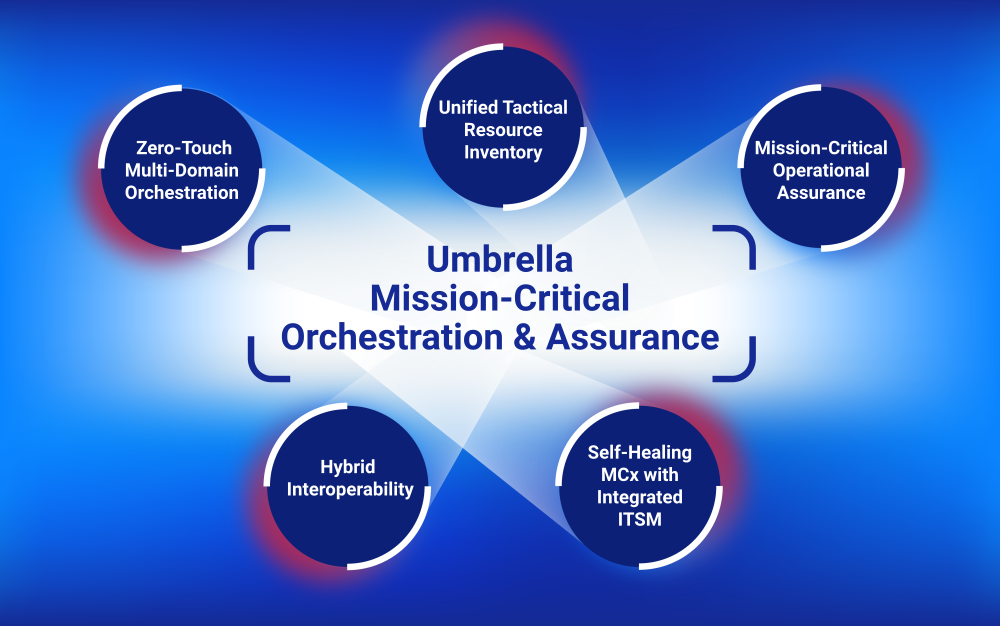
Enable Zero-Touch Multi-Domain Orchestration
Orchestrate Multi-Vendor Layers: Automate E2E workflows across 4G/5G Core registers, SM-DP+ eSIM platforms, MDM/MAM suites, and MCx servers.
Eliminate Provisioning Errors: Enforce mandatory ACK confirmations from every target node before marking any critical service active.
Protect Database Integrity: Execute automated transactional rollbacks to instantly restore databases if any node times out or fails.
Gain Full Sovereignty with Unified Tactical Resource Inventory
Establish a Single Source of Truth: Unify physical, logical, and security resource modeling across legacy narrowband (PMR/TETRA) and modern 3GPP broadband networks.
Enforce Immutable Audit Trails: Maintain digitally signed, tamper-proof configuration logs to ensure operator accountability under NIS2 and sovereign data regulations.
Ensure Mission-Critical Operational Assurance
Unify Cross-Domain Fault Management: Correlate alarms across eNB/gNB towers, transport links, 4G/5G core, MCx servers, and IWF nodes with automated Root Cause Analysis (RCA).
Monitor Real-Time MCx KPIs & SLAs: Track 3GPP quality metrics in real time, including MCPTT call setup time (<300 ms), Floor Request Grant Delay, Packet Error Loss Rate (PELR), and Packet Delay Budget (PDB) across MCX QCIs/5QIs streams.
Bridge Legacy Networks and Broadband via Hybrid Interoperability
Provision Simultaneously Across Hybrid Domains: Execute unified provisioning across 3GPP cores (HSS/UDM), TETRA tactical group registers, and Interworking Function (IWF) nodes in a single operation.
Correlate Cross-Technology Events in Real Time: Aggregate alarms and KPIs from both legacy PMR and 3GPP broadband into a single NOC dashboard to guarantee uninterrupted communications during migration.
Enable Self-Healing MCx with Integrated ITSM
Execute Closed-Loop Self-Healing: Automatically trigger remediation scripts to reroute traffic to backup channels or restart degraded MCx microservices upon detecting performance drops.
Integrate Native ITSM Workflows: Synchronize incidents, problems, and change requests with SLA-based ticket prioritization tailored to specific public safety agencies.
Why Choose Comarch Communications for Umbrella Mission-Critical Orchestration & Assurance




MCx Umbrella Orchestration & Assurance: Key Questions and Answers
In public safety networks, an Operations Support System (OSS) acts as the technical management hub overseeing network resources, operational workflows, and end-to-end service delivery across hybrid broadband and legacy radio infrastructures.
Key operational functions include:
Orchestration & Service Fulfillment: Enables zero-touch multi-domain provisioning across 3GPP cores, eSIM profiles, MDM/EMM, and MCx platforms with mandatory positive confirmations and automated roll-back mechanisms.
Tactical Resource & Asset Inventory: Acts as a unified Single Source of Truth for physical, logical, and security assets, delivering real-time IMEI/IMSI binding and immutable audit logging for NIS2 compliance.
Service Assurance & SLA Monitoring: Delivers cross-domain Fault and Performance Management to monitor sub-300ms MCPTT setup times, track 3GPP quality metrics, and trigger automated closed-loop remediation.
Comarch Communications Umbrella Mission-Critical Orchestration & Assurance provides these capabilities within a fully standardized, 3GPP-compliant framework tailored specifically for PPDR agencies and mission-critical communications.
Comarch Communications Umbrella Mission-Critical Orchestration & Assurance prevents "hanging" or orphaned accounts by executing transactional multi-domain provisioning backed by positive acknowledgment (ACK) verification and automated roll-back mechanisms.
Key safeguards include:
Strict ACK Verification: Enforces a mandatory positive confirmation from every network node, including 3GPP UDM, eSIM SM-DP+, MDM/EMM, and MCx application servers, before finalizing subscriber provisioning.
Automated Roll-Back Workflows: If any individual node fails to respond or returns an error, the system automatically reverts all previously executed steps across all domains to restore databases to a consistent initial state.
Instant NOC Alerting: Generates real-time diagnostic reports and routes failure logs directly to the Network Operations Center (NOC) for immediate visibility and rapid troubleshooting.
By eliminating partial activations and data inconsistencies, Comarch Communications’ platform guarantees strict database integrity and operational reliability for mission-critical PPDR subscriber profiles.
User provisioning in a hybrid network is executed as a single, unified operation that simultaneously coordinates subscriber profiles across both narrowband PMR/TETRA legacy networks and modern 3GPP 4G/5G broadband infrastructures.
The orchestration workflow includes:
Simultaneous Profile Updates: A single provisioning request in the OSS triggers concurrent execution, updating broadband registers (3GPP UDM/HSS).
Automated IWF Parameter Propagation: Automatically configures parameters in the Interworking Function (IWF) bridge to align talkgroup mappings, encryption parameters, and subscriber identities across both domain types.
Unified Identity Alignment: Eliminates manual double-entry and prevents profile mismatches between legacy radio talkgroups and modern 3GPP MCx (MCPTT/MCVideo/MCData) application accounts.
Through this end-to-end multi-technology workflow, Comarch Communications’ platform guarantees uninterrupted cross-network communication and seamless operational migration without service gaps for field personnel.
The Performance Management module continuously monitors specific 3GPP Key Performance Indicators (KPIs), such as MCPTT Call Setup Time, Packet Delay Budget (PDB), and Packet Error Loss Rate (PELR), on MCX QCIs/5QIs streams. If call degradation is detected, the system immediately generates alerts and triggers automated corrective actions.
Unlike siloed monitoring tools, Comarch Communications Umbrella Mission-Critical Orchestration & Assurance provides end-to-end cross-domain correlation and automated Root Cause Analysis (RCA).
Cross-Domain Integration: Correlates telemetry across radio towers, transport networks, 4G/5G core, MCx servers, and legacy PMR systems in a single NOC dashboard.
Automated Root Cause Analysis: Eliminates alarm noise by pinpointing the underlying failure source instantly, preventing alarm fatigue and accelerating fault recovery.
Native integration between the OSS and Service Desk enables automated, SLA-driven ticket creation and intelligent incident routing. Network faults and SLA breaches instantly generate structured Incident, Problem, or Change tickets without manual operator intervention. The system dynamically assigns priority levels based on agency SLAs and automatically routes tickets directly to the responsible technical teams to minimize resolution times.
The Tactical Inventory database serves as a unified Single Source of Truth that binds telecom parameters (IMSI, ICCID, MSISDN), radio identifiers, IP/APN profiles, and physical IMEI data alongside device trust status in a single repository.
By consolidating physical, logical, and security attributes across user equipment and IoT endpoints, it enables real-time asset tracking, automated identity verification, and immutable security audit trails across mission-critical networks.
The Comarch Communications solution mitigates high migration costs and vendor lock-in by acting as an agnostic overlay brain, leveraging certified TM Forum Open APIs and standard 3GPP interfaces.
It integrates southbound with 5G Cores (including UDM), SM-DP+ platforms, and MDM servers to enable zero-touch provisioning. Crucially for hybrid networks, it connects directly with legacy TETRA subscriber registries and Interworking Functions (IWF), enabling single-action dual-provisioning across both PMR and broadband domains.
For service assurance, the platform digests telemetry via Kafka, Syslog, or SNMP from RAN controllers, transport links, and MCx application servers. This open architecture seamlessly orchestrates complex multi-vendor ecosystems without expensive "rip-and-replace" scenarios, drastically lowering integration overhead.
The platform leverages standardized RESTful TM Forum Open APIs across core service, resource, and operational assurance domains:
Service Domain: Service Ordering (TMF641), Service Catalog Management (TMF633), and Service Inventory (TMF638).
Resource Domain: Resource Ordering (TMF652) and Resource Inventory (TMF639).
Operational Assurance: Alarm Management (TMF642) and Performance Management (TMF628).
These standardized interfaces enable out-of-the-box interoperability with multi-vendor 5G Cores, legacy PMR systems, and MCx application servers, eliminating vendor lock-in.
The Comarch Communications solution provides the technical foundation required under NIS2 and critical infrastructure laws. The platform generates cryptographically signed, immutable audit trails (ensuring non-repudiation) for all administrative configurations, provisioning workflows, and lifecycle changes. It features granular Role-Based Access Control (RBAC), multi-tenant agency isolation, and real-time hardware-subscription (IMEI-IMSI) trust verification. Furthermore, it streams security events directly into national SOC/SIEM centers for automated threat monitoring.
Traditional telecom OSS, point-solution Network Management Systems (NMS), and domain-isolated Assurance tools focus on tracking siloed network elements and standard commercial SLAs. In contrast, Comarch Communications Umbrella Mission-Critical Orchestration & Assurance is purpose-built for Public Protection and Disaster Relief (PPDR) and critical infrastructure operations, delivering an end-to-end, cross-domain orchestration layer engineered for strict life-safety requirements.
The platform delivers distinct operational advantages over generic market alternatives across four core pillars:
- Cross-Domain Correlation vs. Siloed Element Monitoring: Correlates real-time events, alarms, and Key Performance Indicators (KPIs) across RAN, Core, transport, and MCx application layers (including legacy PMR/TETRA/P25 and 3GPP 4G/5G broadband) into a single operational pane to enable immediate root-cause analysis.
- Unified Resource & Service Model vs. Fragmented Tools: Integrates tactical resource inventory, active service topologies, and real-time fault management into a single source of truth aligned with TM Forum (TMF) Open Digital Architecture (ODA).
- Native Critical Communications & Cyber Resilience vs. Generic Mobile OSS: Tailored to strict government and utility mandates, supporting sub-300 ms MCPTT latency targets, IMEI-IMSI hardware-to-subscription trust binding, NIS2-compliant immutable audit trails, and real-time streaming event feeds to national SOC/SIEM systems.
- Closed-Loop Automation vs. Manual NOC Workflows: Features out-of-the-box automation to enable zero-touch service fulfillment, automated incident routing, and self-healing corrective actions when service quality thresholds degrade.
Backed by global deployment references, certified TM Forum Open APIs, native SOC integration, and Agentic AI readiness, Comarch Communications eliminates operational silos to safeguard critical communication systems.

Optimize and scale your business with our experts
Share your technical or business challenges with us. Drop a line to discuss your requirements, and we will guide you through. We will show you how our technology can be applied to your company’s individual needs.