




Join our newsletter to receive meaningful updates, expert insights, and resources tailored to your interests. We promise to keep our communication valuable - never overwhelming.
Insights from Comarch Communications’ First IoT Connectivity Forum: AI, Massive SIM Rollouts, and New GSMA Standards
Around: 5 min. read

The Internet of Things landscape offers immense business opportunities but also poses profoundly complex challenges for the global telecommunications industry. As billions of new devices come online worldwide, operators are forced to rethink their entire foundational infrastructure.
At this year’s Comarch Communications User Group 2026, the first IoT Connectivity Forum looked at how industry leaders are tackling these challenges. The event showed how moving past old network limitations and using artificial intelligence can shape the future of connected devices. Speakers agreed that staying competitive in the next decade will require big changes in both technology and business strategy.
Escaping the dumb pipe infrastructure model
A major theme of the forum was learning from past mistakes to secure future profitability. Dariusz Jędraszek, IoT Product Marketing Manager, diagnosed a massive industry problem by recalling the collective trauma of the 4G network era. During that period, mobile operators acted merely as a basic conduit, essentially providing raw connectivity while massive tech giants and streaming services reaped the vast majority of the financial profits, a model referred to as “dumb pipe.”
To prevent this misstep from recurring in the 5G era, Dariusz advocated for a transition toward an API economy. By intelligently leveraging standardized CAMARA interfaces and the Network Exposure Function, operators can finally manage programmable Quality of Service and seamlessly open these advanced network capabilities directly to their business customers. This allows enterprises to request customized network slices on demand for critical applications.
However, possessing advanced technology alone cannot automatically drive revenue growth. Sławomir Nowak, IoT Solution Manager, pragmatically noted that true monetization requires entirely modern billing models built on the TM Forum Open Digital Architecture. This fundamental shift will ultimately allow connectivity providers to sell precise microservices and highly flexible data packages based on specific service-level agreements, definitively moving away from the outdated, highly unprofitable model of selling empty megabytes to global enterprises.

Stateless platforms and event-driven network management
Handling the scale of Massive IoT, which involves targeting tens of millions of active SIM cards per enterprise client, demands robust infrastructure changes. Radosław Sawicki, IoT Product Manager, presented the case for an immediate evolution toward a completely stateless platform architecture. Separating user data from processing nodes enables connectivity platforms to process up to 2.4 billion daily usage records and survive massive traffic spikes without catastrophic failures.
Connecting these large device fleets to 5G networks also highlights the problems with older methods, such as constant network polling. Continuous status polling drains device batteries and can overload the network with too many signals. Jędraszek suggested using an event-driven approach with the 5G-Advanced RedCap standard. In this setup, the network only responds when a specific event occurs, such as a 15-degree tilt, 10 km/h acceleration, or moving more than 50 meters. 5G RedCap in 3GPP Release 18 replaces older LTE Cat-1 modules, offering about 150 Mbps for fast vehicles and making devices simpler. The TS 38.305 standard also enables 5G networks to track indoor locations with sub-meter accuracy, making traditional GPS less necessary.
Resolving the eSIM bootstrap challenge
Another big topic was the high cost of connecting devices to foreign networks, known as the “bootstrap” problem. In the past, the SGP.02 standard used a “Push” setup with a central SM-SR router, which caused vendor lock-in and high switching costs. The SGP.22 consumer standard added an SM-DP+ cloud but needed QR code scanning, which does not work for millions of remote devices like smart meters. Forum speakers said new electronic SIM standards are the answer. The SGP.32 standard moves profile management to the cloud and uses a micro IPA agent on the device, allowing provider switching for 100,000 profiles with one zero-touch API call. The SGP.42 standard adds In-Factory Profile Provisioning, letting the operator’s profile be securely added to the iSIM chip during manufacturing. This removes the need for costly initial roaming.
Software complexity and Agentic AI integration
Maciej Burczyk, Head of Smart BSS/IoT Connect Business Unit, discussed the challenges of launching products quickly under market pressure. He warned that rushing to market without managing software complexity leads to what he calls “false speed.” This can cause hidden flaws that result in expensive outages and rising bug-fix costs. Burczyk suggested using modern methods such as Canary Releases and Shadow Runs in clustered systems to balance fast deployment with high reliability.
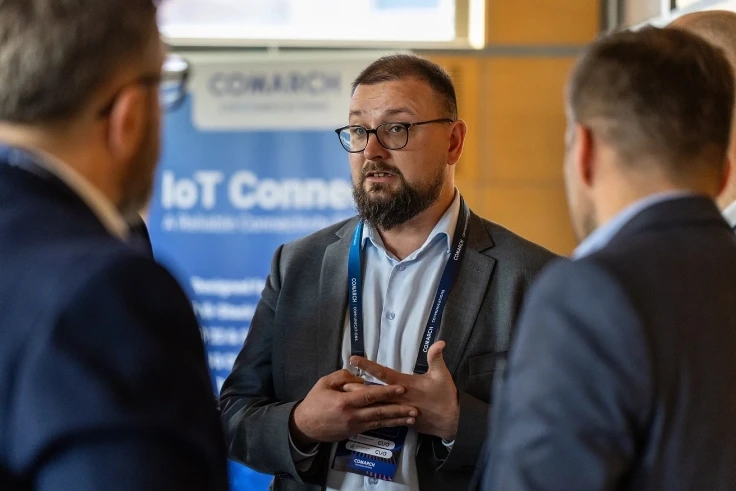
As network complexity and the volume of operational logs increase, relying solely on manual human engineering for diagnostics becomes an inefficient bottleneck. Paweł Brożyna, Head of IoT R&D, outlined the adaptation of Agentic AI to address this operational overload. Implementing artificial intelligence at the Level 3 (L3) conditional autonomy stage allows operators to deploy tools such as the “AI Bug Analyzer”. These multi-modular systems can independently correlate millions of lines of production logs with Jira error descriptions to proactively locate the root causes of billing failures and network degradations without human intervention. This shift relieves network engineers from routine troubleshooting tasks, allowing them to redirect their focus toward developing new enterprise services.
A checkpoint for the IoT industry
The inaugural IoT Connectivity Forum made clear that unifying disparate technological forces into a cohesive ecosystem is both the greatest challenge and the ultimate opportunity for operators. The maturation of eSIM standards, precise 5G Advanced tracking, and flexible location-based billing models prove that monetizing the network infrastructure itself is entirely possible. Those who ignore this paradigm shift risk remaining passive conduits for someone else’s profits, but the tools to build the digital future are here for those ready to become its architects.

7 min. read
Space ODA: Integrating SatCom into the Terrestrial 5G/6G Ecosystem
6 min. read
Going Hybrid and Zero-Trust: Uniting the Sector at Critical Communications World 2026
4 min. read
Building the Foundation for AI-Native Networks: How Telecom Operators Can Prepare for 6G?
7 min. read
Going Techco: AI-Native Architecture, Digital Twins, and the End of the Monolith Era at DTW Ignite 2026
8 min. read
The EU AI Act: A Practical Guide to Compliance for Business and Technology Leaders
9 min. read
Comarch User Group 2026: Together Towards The AI-Driven Future of Connectivity
5 min. read
The Surge of eSIM, iSIM, and RedCap Device Deployments in IoT ApplicationsSign up for more insightful content