


Join our newsletter to receive meaningful updates, expert insights, and resources tailored to your interests. We promise to keep our communication valuable - never overwhelming.
Comarch User Group 2026: Together Towards The AI-Driven Future of Connectivity
Around: 9 min. read
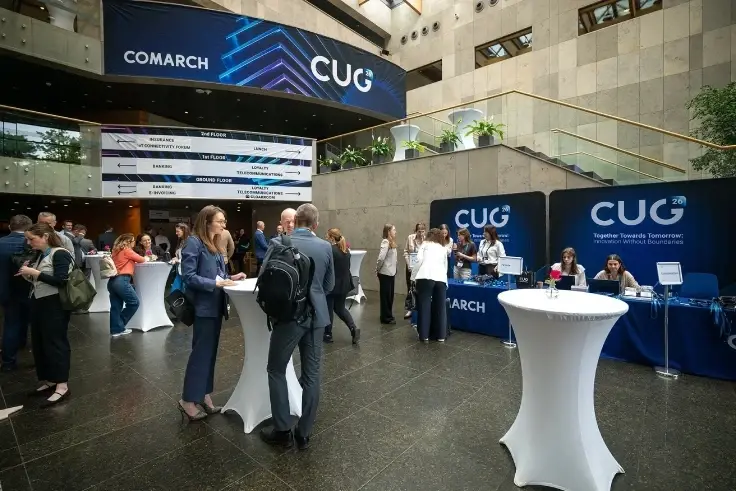
We have recently closed another record-breaking edition of our annual Comarch User Group conference. This year, we welcomed 200 participants representing 46 companies from 22 countries, including South Korea, Reunion Island, Libya, the Ivory Coast, Japan, the United States of America, the United Arab Emirates, as well as Italy, Germany, Belgium, the United Kingdom, Finland, and others, to discuss the trends and challenges defining the future of our industry.
It was also the first edition in which we appeared as Comarch Communications and could present our rebranding journey and the results of our official expansion to new sectors, such as satellite connectivity, critical infrastructure, and logistics.
Over three days of workshops, discussions, and presentations, together with our partners and clients, we explored how deep expertise and AI-driven tools are completely reshaping global connectivity, ensuring that our partners remain competitive in a rapidly changing world.
The strategic rebranding and the vision for global growth
The second day of the conference in the Telecommunications Stream began with an opening speech by Marcin Kaleta, CEO of Comarch Communications, who presented the journey and results of our rebranding from Comarch Telecommunications to Comarch Communications that took place over the past year. He explained that this is a massive internal transformation driven by over 100 value creation initiatives and new growth that has allowed us to successfully expand into markets such as satellite networks, critical infrastructure, and logistics.
“For us it means that we want to provide you better quality, better projects, faster projects, even cheaper projects," he commented.
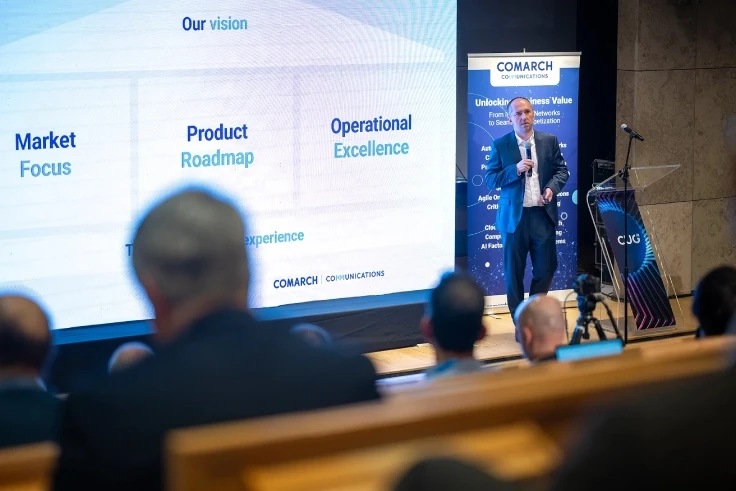
Tymoteusz Wrona, Chief Strategy and Operations Officer at Comarch Communications, expanded on this vision by explaining how the industry is rapidly transitioning to an API economy, leveraging standards such as CAMARA to expose network capabilities directly to enterprise clients. Wrona warned that without opening network functions, providers risk becoming simple data pipes just as they did during the 4G era. He laid out a product roadmap entirely focused on massive scalability, autonomous networks, and intent-based systems that allow machines to dynamically negotiate network slicing.
Autonomous networks and AI adoption for engineering excellence
The afternoon sessions dedicated significant time to internal engineering excellence and discussing how AI optimizes workflows and influences the industry. We started with Zackaria Farhat from Makman Technology Consulting, who delivered a masterclass on debunking myths about autonomous networks. He clarified that true TM Forum Level four autonomy is fundamentally about delegating operational responsibility to machines rather than simply writing automation rules. Using a brilliant restaurant analogy, he explained how intent must flow from the business owner down to the kitchen without micromanagement. He strongly advised companies to fix their underlying data platforms first, noting that an AI agent is completely useless if it operates on siloed data.
"Only 6% of CSVs have a data streaming capability. And if you don't invest here, if you're not part of the 6%. That means you will have a data block or problem before you have an AI problem," he warned.
Later, Marek Kuczyński and Wojciech Wiśniowski joined Anshuman Pandey from Augment Code to discuss how we transformed our software development process with AI tools. Pandey explained that standard large language models hit a context wall when processing millions of lines of code and how Augment approached this issue. Thanks to the Deep Context AI engine, Comarch Communications developers gained a powerful tool that allows them to deploy new product features faster and with fewer bugs than ever before. This is accompanied by smart token optimization – simple tasks are delegated to less powerful AI models, saving the premium computing resources for the critical areas that require their full potential.
Following this presentation, Anna Szczurowska-Tuziak, Associate Partner at McKinsey & Company, and Łukasz Maślaniec, Head of Value Creation Plan at Comarch, detailed the journey of AI adoption at scale. They explained that simply buying software licenses is never enough. Instead, they designed a medical residency-style training program, using 31 internal coaches to successfully train over 1,500 developers in just 4 months, resulting in a 93% positive adoption rate.
Discussing the needs and challenges of the critical communications market
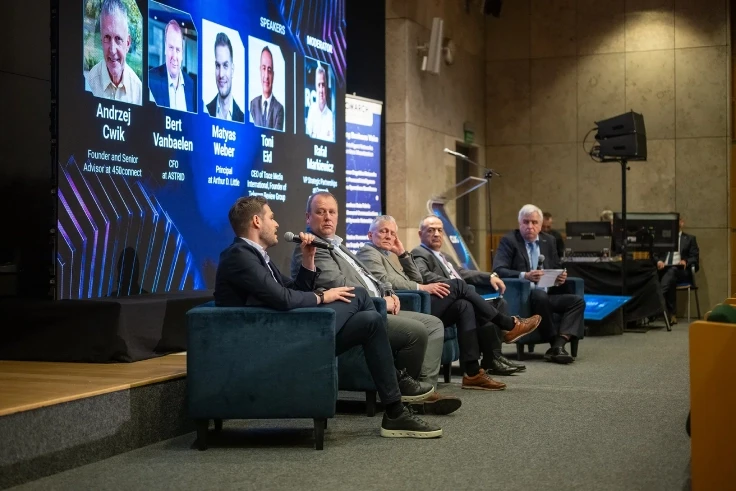
Our partners and clients presented their perspectives on the state of the critical connectivity industry through a panel moderated by Rafał Markiewicz, featuring Bert Vanbaelen (ASTRID), Andrzej Ćwik (450connect), Toni Eid (Trace Media, Telecom Review Group), and Matyas Weber (Arthur D Little). Vanbaelen shared his experience running the public safety network in Belgium, detailing their transition from legacy networks to a highly resilient hybrid 5G broadband model. The panelists unanimously agreed that while commercial networks are highly useful, true mission-critical scenarios require dedicated hardened infrastructure capable of surviving extreme systemic stress.
Roadmap for Comarch Communications’ OSS and BSS products
During the conference, we unveiled our 2026/2027 roadmaps for the BSS and OSS products, which prioritize flexibility and pragmatic AI features designed to solve significant operational bottlenecks, accelerate cash flow, and make commercial innovation absolutely safe.
Jacek Prokop, BSS Product Marketing Manager, introduced the Comarch Communications Cloud Billing engine and shared the roadmap for Composable BSS. He talked about the industry's main challenge: technological debt from old, monolithic systems. To solve this, he demonstrated a composable architecture that enables providers to add high-performance BSS modules without replacing their entire IT systems.
One key feature is a practical use of AI, moving beyond basic chatbots to a strong system that helps cut call center costs. This is powered by an internal group of 15 AI agents that can, for example, explain invoice spikes to users or run real-time simulations to help customers avoid unexpected fees. The Composable BSS also includes an operational digital twin, a secure test environment where teams can safely try out new product setups using real data, eliminating the risk of new market launches.
Later, Marcin Nowak, Head of OSS Product Management, presented the development plan for Comarch Communications OSS. He showcased a use-case demo in which AI agents automatically rerouted network traffic to avoid faulty interfaces thanks to AI-ready data provided by a Medallion Lakehouse architecture.
To maintain strict control over autonomous processes, he also introduced "adversarial agents." These are special bots that monitor and check the work of other agents to keep the system safe. They act as internal auditors, tracking system conversations and collecting feedback on AI operations. This ongoing oversight helps the system improve reliability and ensures strong governance.
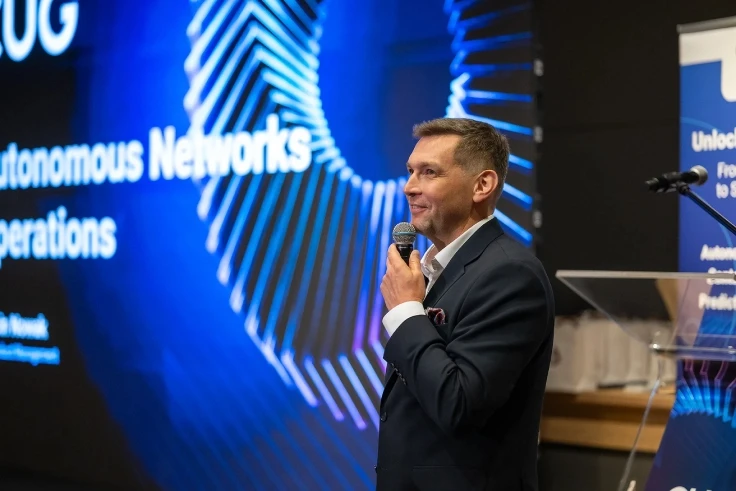
Finally, Marcin highlighted a strong commitment to an open, collaborative technological ecosystem. Acknowledging that operators are investing heavily in their own proprietary intelligence, he stated:
"The reality is obviously all of the companies in the market are investing in AI. So you have a choice, either our agents, our stack of functionalities, or yours."
To support this, the new roadmap provides comprehensive integration toolkits, advanced APIs, and an ecosystem of MCP servers that empower service providers to seamlessly integrate their preferred models or independently develop customized virtual agents tailored perfectly to their unique operational environments.
The first-ever IoT Connectivity forum
The first Comarch IoT Forum revealed the business opportunities and architectural challenges of IoT technology in the 5G era.
Dariusz Jędraszek explained the industry’s shift from the restrictive SGP.02 and impractical SGP.22 standards to the revolutionary SGP.32, which introduces a cloud-based eIM orchestrator enabling “zero-touch” provider switching via simple API calls. He also highlighted SGP.42, which allows for factory-level cryptographic profile injection to eliminate costly initial roaming periods.
To avoid battery drain and signal storms, networks must adopt an event-driven architecture in which devices communicate only when physical thresholds are breached. To handle this massive scale, Radosław Sawicki announced the necessary transition to stateless platform architectures capable of processing 2.4 billion daily usage records effortlessly.
Sławomir Nowak stressed the need to escape the “dumb pipe” syndrome by embracing the API economy, where standardized CAMARA interfaces and the NEF network function finally allow for programmable network quality of service (QoS) management and open it up to B2B customers.
Maciej Burczyk warned of rushed deployments leading to painful outages. He advocated for safe operational practices, such as Canary Releases and Shadow Runs.
Finally, Paweł Brożyna demonstrated that diagnosing massive IoT faults exceeds human cognitive limits, introducing Agentic AI (such as the AI Bug Analyzer) to autonomously analyze root causes of errors without human intervention. This will allow engineers to focus on real innovations instead of constantly putting out infrastructure fires.
The essence of the forum and an excellent prognosis for the future was the discussion of the needs and visions of Comarch Communications’ customers, which will enable faster, more satisfying solution delivery and the acquisition of new users, as verified by the practical operation of the solutions.
Real-world implementations and success stories
Theory is important, but it is the practical application that changes reality. Ahmed Jarallah from Hatif Libya shared a phenomenal client success story. He detailed how Hatif Libya partnered with Comarch Communications to transform from a legacy infrastructure owner into a Libyan digital orchestrator. By automating their provisioning systems, they reduced service activation times from several weeks to mere hours while implementing real-time fault detection across their massive fiber network.
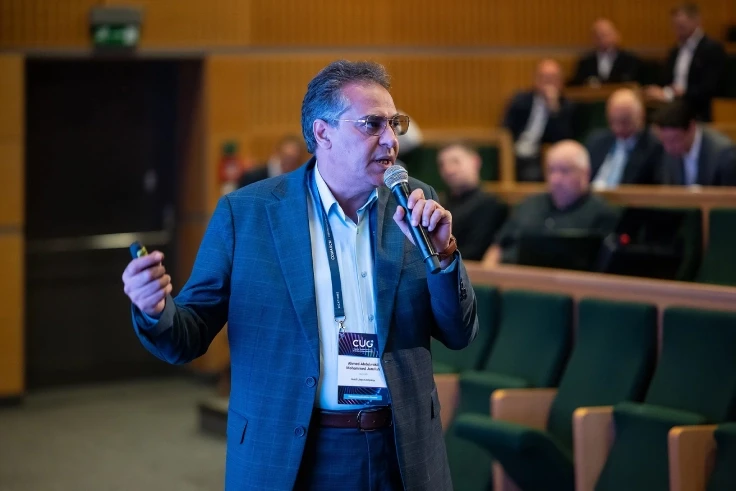
David McKinnon from PG&E shared how Pacific Gas and Electric used Comarch Communications OSS to reimagine utility network operations. The implementation resulted in significant change cycle time reduction, advanced power management, and simplified routing hierarchies for technicians.
Seokin Kang from LG CNS provided the perspective of a global integration partner. He discussed the successful deployment of the Comarch Communications OSS platform for LG U+ in South Korea. He highlighted how LG CNS served as the bridge, preserving LG U+'s unique local business processes while maintaining the core architecture of Comarch Communications’ platform.
Celebrating decades of collaboration and trust
The conference concluded with an inspiring closing speech from Paweł Workiewicz, Chief Commercial Officer at Comarch Communications. He summarized the incredible journey of the conference, reinforcing the company's commitment to autonomous networks, critical connectivity, and composable architecture. The event ended on a beautiful note with a special award ceremony honoring our long-standing clients, starting with Orange, which holds the proud title of being our very first customer. Our journey began more than 30 years ago with the implementation of an inventory solution, and remarkably, that original system is still successfully up and running today.
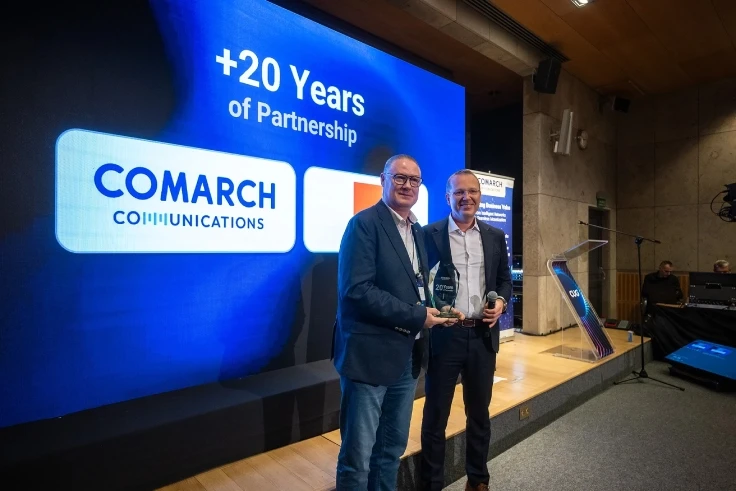
Several major European operators were honored for surpassing two decades of continuous collaboration: T-Mobile Polska (noted specifically for being the pioneer user of Comarch Communications' Assurance and Fault Management systems), Telefónica, and Deutsche Telekom. The ceremony also recognized outstanding 15-year-long relationships with Netia, Bite Group, and KPN.
The Comarch User Group 2026 was a defining moment for our global community, proving that by combining deep industry expertise with cutting-edge Agentic AI, we are fully prepared to build the future of communications together.

7 min. read
Space ODA: Integrating SatCom into the Terrestrial 5G/6G Ecosystem
6 min. read
Going Hybrid and Zero-Trust: Uniting the Sector at Critical Communications World 2026
4 min. read
Building the Foundation for AI-Native Networks: How Telecom Operators Can Prepare for 6G?
7 min. read
Going Techco: AI-Native Architecture, Digital Twins, and the End of the Monolith Era at DTW Ignite 2026
8 min. read
The EU AI Act: A Practical Guide to Compliance for Business and Technology Leaders
5 min. read
Insights from Comarch Communications’ First IoT Connectivity Forum: AI, Massive SIM Rollouts, and New GSMA Standards
5 min. read
The Surge of eSIM, iSIM, and RedCap Device Deployments in IoT ApplicationsSign up for more insightful content