




Join our newsletter to receive meaningful updates, expert insights, and resources tailored to your interests. We promise to keep our communication valuable - never overwhelming.
Going Techco: AI-Native Architecture, Digital Twins, and the End of the Monolith Era at DTW Ignite 2026
Around: 7 min. read
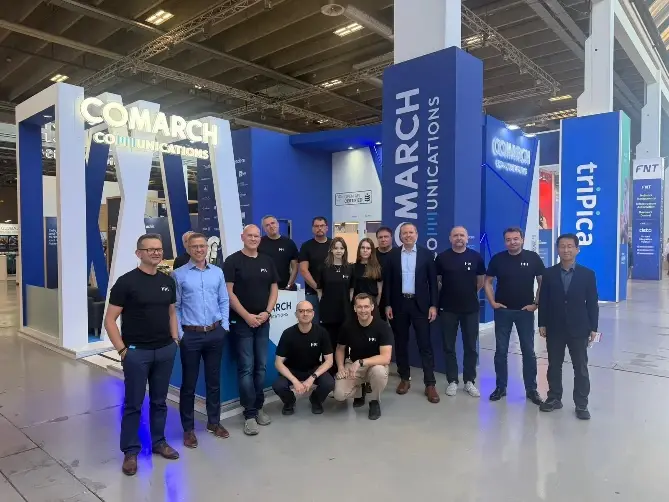
This year's DTW Ignite 2026 conference, organized in Copenhagen by TM Forum under the apt slogan "The Future. Faster," leaves no room for doubt. From the perspective of an observer of the digital communications market, the conclusion is clear: the global industry is finally moving beyond laboratory testing and toward the mass, rigorous implementation of artificial intelligence. The traditional communications provider ("Telco") model is irrevocably giving way to flexible, algorithm-based technology platforms ("Techco").
Below are the most important architectural trends discussed during the panels, along with a detailed look at how innovative technologies from the Comarch Communications portfolio are already addressing these major market challenges.
Deconstructing IT monoliths and reinventing ODA
A key point of this year's discussions was the absolute requirement to abandon outdated support systems in favor of flexibility.
- Scott Petty (Vodafone): He strongly pointed out the urgent need to replace monolithic BSS/OSS environments with distributed ones, specifically microservices, where decision-making algorithms constitute the core of the service.
- Nik Willetts and Aaron Boasman-Patel (TM Forum): They announced an AI-native evolution of the standard Open Digital Architecture (AI-Native ODA) and the launch of the ODA for Satellite initiative.
- Mats Karlsson (Ericsson): He pointed out that the potential of even the most powerful AI models is completely stifled by the sluggishness of legacy architectures.
Comarch Communications' portfolio is a prime example of the technological transition from archaic IT monoliths to the era of modular software. The company's entire modern architecture is fully based on microservices and is officially certified for compliance with TM Forum Open Digital Architecture standards. Furthermore, Comarch Communications systems not only guarantee a highly seamless transformation to cloud environments (Cloud-Native), ensuring full scalability, but also embed advanced data analytics directly into the core code of the operating and billing systems. This implementation is a direct and accurate response to the rigorous requirements of the new operational space described by TM Forum leaders.
Digital Twins: A lifesaver for legacy environments
Technical debt remains a hurdle to transformation, but engineering is finding effective and efficient ways to address it. At the event, startups such as Codaxy and NumoData demonstrated how semantic overlays based on ontologies and knowledge graphs help organize chaotic data without the need for immediate and expensive hardware replacement in so-called brownfield environments.
A deep rebuild of legacy infrastructure carries massive risk. Comarch Communications effectively addresses this market pain point by implementing Resource Management and Network Auto-Discovery & Reconciliation platforms. These technologies serve as a critical foundation for building complete, networked Digital Twins. Instead of a risky "rip-and-replace" operation, Comarch Communications tools precisely organize degraded data and build a fully integrated analytical layer over it. As a result, old equipment is unleashed, giving operators 100% resource visibility and immediate readiness for AI implementations.
AIOps, autonomous networks, and technology alliances
The discussion panels were dominated by metrics for cutting operational costs and automating telecommunications networks.
- Mark Sanders (Telstra): He justified the development of autonomy (levels 0-5) solely by the strict requirement of achieving an immediate return on investment (ROI) from business-validated scenarios.
- Howard Watson (BT): He warned that closed-loop automation and access to deterministic data are absolute prerequisites for production safety.
- Harmeen Mehta: She presented the role of engineers as supervisors of LLMs and automated assistants, while industry giants (like Nokia and Ericsson) showcased applications and apps integrating automation directly into the network core.
The evolution toward intelligent systems operating at a minimum of Level 4 network autonomy is a key development pillar for Comarch Communications. The systems fully implement the vital concept of closed-loop automation, the security of which was emphasized on stage by BT's representative. Based on highly accurate predictive machine learning (ML) models, Comarch Communications directly automates complex correlation processes for thousands of events, conducts rapid root-cause analysis, and executes self-healing scenarios. This drastically minimizes OPEX metrics and secures a hard, verifiable ROI.
Trusted AI (Sovereign AI) and advanced Agentic AI models
Today, corporate analytics must be absolutely secure and controlled at every step of the way.
- Ashraf Elgazzar (Qeema): He emphasized the need to build strictly managed policy environments, postulating that multi-domain fault correlation must be performed while maintaining a cryptographic guarantee of data integrity between agents (A2A runtime).
In an era that places such a strong emphasis on trusted, corporate artificial intelligence (Sovereign AI), Comarch Communications' architects demonstrate tremendous pragmatism. Algorithmic models function as highly supervised ecosystems, governed by a strict policy architecture. The company's proprietary modules, responsible for multi-domain error correlation across disparate network segments, operate within a completely hermetic, isolated operator ecosystem. This provides an unwavering barrier for sensitive operational data, successfully combining the capabilities of independent AI Agents with the strict security guidelines required to build credibility for any of today's "Techco" operators.
API economics and monetization in the NaaS model
The main profit streams are shifting from hardware to layers of clean programming code.
- Mark Newman (TM Forum) and Peter Arbitter (Deutsche Telekom): They unanimously called for a rapid transformation towards Network-as-a-Service (NaaS). They warned that operator inaction would lead to domination by IT giants and pointed to solutions like Open APIs and the CAMARA project as ways to monetize network features.
Infrastructure monetization based on the API Economy finds a powerful technical reflection in Comarch Communications platforms, which boast market leadership in TM Forum Open APIs architecture compliance. Their systems seamlessly support open programming initiatives (such as CAMARA), allowing operators to securely transform into digital platforms for third-party developers. The Comarch Communications platform automates the entire digital service lifecycle from start to finish, flawlessly translating developer requests into instant, metered billing for modern B2B and B2B2X business models.
Proactive Customer Experience (CX) and digital trust
The culmination of the entire technological process is always the sentiment and loyalty of the end user.
- Ruza Sabanovic and Claire Gillies (BT): They warned management against reducing AI to merely a tool for job cuts. The future lies in engines, such as Next Best Action, that aggressively preempt subscriber complaints, as well as ruthless filters that block millions of scam attempts—directly fueling the brand's digital trust capital.
Comarch Communications systems perfectly align with this predictive vision. Advanced analytical engines combine real-time technical telemetry with subscriber billing profiles, proactively analyzing quality of service (QoS/QoE) parameters. This enables an unprecedented achievement: the Comarch Communications system can detect drastic network degradation or impending failure, automatically triggering compensation and self-healing processes before the subscriber even picks up the phone to file a complaint. This is "proactive CX" redefined.
The merciless execution phase and escaping the specter of the "dumb pipe"
An in-depth analysis of this year's DTW Ignite 2026 in Copenhagen leaves no doubt. The industry has stopped debating the mere merits of innovation and has instead focused on ruthless execution and optimization.
Market leaders will soon enforce a drastic reduction in mean time to repair (MTTR), strict energy efficiency standards, and the use of artificial intelligence to optimize radio access networks (RAN). A key competitive advantage will be flexible modular architecture, broadly described as Composable IT, which protects infrastructure against image-damaging downtime. Technologies provided by partners like Comarch Communications put bold operators in an ideal position to successfully transform into IT platforms for Industry 4.0. Competitors who skimp on investments and are late to implement agile architectures will face dire consequences—permanently reduced to a low-margin and invisible infrastructure layer, known in engineering slang as a "dumb pipe." The race for technological superiority has begun in earnest.

7 min. read
Space ODA: Integrating SatCom into the Terrestrial 5G/6G Ecosystem
6 min. read
Going Hybrid and Zero-Trust: Uniting the Sector at Critical Communications World 2026
4 min. read
Building the Foundation for AI-Native Networks: How Telecom Operators Can Prepare for 6G?
8 min. read
The EU AI Act: A Practical Guide to Compliance for Business and Technology Leaders
5 min. read
Insights from Comarch Communications’ First IoT Connectivity Forum: AI, Massive SIM Rollouts, and New GSMA Standards
9 min. read
Comarch User Group 2026: Together Towards The AI-Driven Future of Connectivity
5 min. read
The Surge of eSIM, iSIM, and RedCap Device Deployments in IoT ApplicationsSign up for more insightful content