






Join our newsletter to receive meaningful updates, expert insights, and resources tailored to your interests. We promise to keep our communication valuable - never overwhelming.
The Progress and Potential of Artifical Intelligence in the IoT
Around: 3 min. read
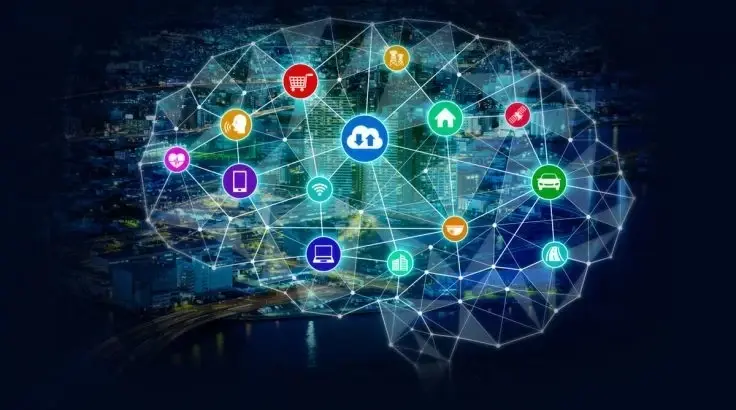
AI (artificial intelligence) and ML (machine learning) increasingly visible in our lives. Most people will be familiar with domestic appliances such as robot vacuum cleaners, which can learn the layout of a room; the banking sector implements AI and ML to identify anomalies and protect our personal finances; and online retailers use this technology to offer carefully tailored products and services.
The Internet of Things (IoT), the complex web of interconnected devices in our homes, workplaces, cars and cities, relies heavily on AI and ML to ease the paths of our daily lives and optimize business operations across many industry sectors. To those already mentioned, we might add manufacturing (for monitoring and automating processes and predicting problems before they cost money), healthcare (automatically notifying doctors if a patient’s vital signs show dangerous changes) and logistics (tracking vehicles and planning routes). That list isn’t comprehensive, but it does indicate that a rising number of devices and sensors deployed across many industries is generating an unprecedented volume of data that is impossible to utilize without the assistance of AI and ML.
So, AI and ML are practical necessities.
They are also perfectly designed to handle rising customer demand for sophisticated services, for example in cross-vertical offers such as the security, optimization, logistics and insurance elements of connected cars. In addition, AI and ML can help companies detect and remove anomalies, security issues and errors.
This all adds up to a better customer experience, lower costs, and more effective solutions that bring tangible benefits to individuals and those who use their services. For example, a heart monitor enabled with ML can not only detect changes in vital signs but also learn to recognize when this is due to a brisk workout and when it’s something requiring medical attention. When your preferred home entertainment provider sends you information about a new film or TV show, it’s very likely to be something you actually want to see. When a sensor detects that an ATM is on the move (yes, it’s happened), the bank knows there is an urgent security problem. And, if a truck making a delivery to Brussels spends an unexpectedly long time stationary in Amsterdam, the HR department knows it’s time to have a chat with the driver.
Of course, it would be a mistake to treat AI and ML as some kind of panacea.
Sometimes, a simple algorithm might do the job more quickly and cost-effectively. And it should be remembered that IT is only as good as the people behind it; it can be more cost and time-effective to deploy human skills and know-how to optimize ML mechanisms with pre-defined, algorithm-based responses and direct them towards the required solutions.
It is by understanding and correctly utilizing this combination of AI, ML, IoT and human potential that organizations can set themselves apart from the competition. Those who fail in any of these aspects – or who ignore AI completely – are destined to fail.

7 min. read
Space ODA: Integrating SatCom into the Terrestrial 5G/6G Ecosystem
6 min. read
Going Hybrid and Zero-Trust: Uniting the Sector at Critical Communications World 2026
4 min. read
Building the Foundation for AI-Native Networks: How Telecom Operators Can Prepare for 6G?
7 min. read
Going Techco: AI-Native Architecture, Digital Twins, and the End of the Monolith Era at DTW Ignite 2026
8 min. read
The EU AI Act: A Practical Guide to Compliance for Business and Technology Leaders
5 min. read
Insights from Comarch Communications’ First IoT Connectivity Forum: AI, Massive SIM Rollouts, and New GSMA Standards
9 min. read
Comarch User Group 2026: Together Towards The AI-Driven Future of ConnectivitySign up for more insightful content