




Join our newsletter to receive meaningful updates, expert insights, and resources tailored to your interests. We promise to keep our communication valuable - never overwhelming.
Industry 4.0 Gaining Ground
Around: 3 min. read
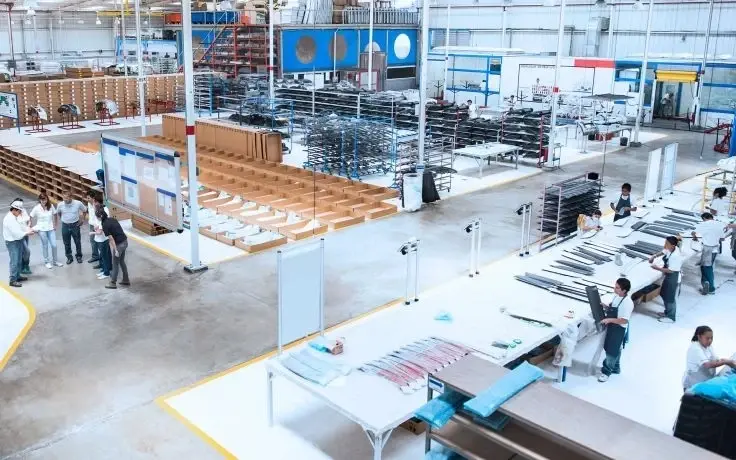
Looking ahead, we can say with confidence that neither technological progress nor the pursuit of innovation will stop, and that industrial ambitions will remain high.
However, as businesses are coping with various global challenges such as digitization and the pandemic, the speed of change might not be as rapid as we would hope. Given the need for business safety and security in particular, diligence and prudence will still prevail.
AI-on-5G and unfolding Industry 4.0
5G propagation is creating new opportunities for edge computing and artificial intelligence. AI coupled with 5G unlocks the potential of Industry 4.0 and its deployment models such as the Smart Factory concept.
Over the coming year(s), connected infrastructure and intelligent spaces will stimulate further growth of automation and robotization, as well as the deployment of preventive and predictive maintenance models.
We should anticipate more businesses investing their efforts in predictive maintenance. This, powered by ML algorithms, telemetry, CCTV, sensors, drones and tracking wearables, can revolutionize the manufacturing sector. What will also be exciting and crucial for success is the merge of this ecosystem (the brain and the driving force) with operational technology and FSM solutions (the executive arm).
Cloud adoption will go mainstream
Acceleration in cloud adoption will enable more manufacturers to enjoy the benefits of advanced analytics and decision-making, and facilitate further deployment of the Smart Factory model.
Aside from that, moving a company’s processes to the cloud can reduce some of the operating costs, simplify integration processes and facilitate business growth, as scaling of resources and infrastructure becomes much easier. In the world of remote working, the cloud also enables knowledge sharing anywhere and at any time between distributed workforce.
Digital twins will go big
The global digital twin market size, which was $3.2 billion in 2020, will likely reach $184.5 billion by 2030 (a 50% CAGR between 2020 and 2030), according to “Research and Markets”. It is clear that we are currently only scratching the surface and starting to unlock its potential.
Further adoption of IoT and sensors will stimulate the deployment of digital twins. Thanks to digital representation of the physical infrastructure and processes, businesses will be able to better conduct tests, and simulate real business operations and equipment behavior in changing conditions - all without the need to incur exorbitant costs of product development or bearing the risks of costly failures.
The need for remote work will go unchanged
First, though it might have been perceived as a short-term reaction to the pandemic, remote working is becoming a more permanent trend. Therefore, manufacturers are finding a way to successfully manage a distributed workforce and mitigate risks related to social distancing.
With travel restrictions and local lockdowns in place, as well as serious workforce shortages, FSM (Field Service Management) tools equipped with assisted video calling will support field operations in ensuring that the right local personnel are on-site and on time, and empowered by remote guidance from experts where necessary.
This new remote working model can significantly reduce cost and safety hazards in an organization, as well as improve performance outcomes.
Industry 4.0 and… 5.0?
Businesses and manufacturers are starting to grasp the concept of Industry 5.0, but it is still a vision or ongoing trend rather than a reality. Nevertheless, the faster the businesses absorb the fact that the role of industry must aim beyond efficiency and productivity and strive to reinforce its own meaning and contribution to society and the planet, the better for us.

7 min. read
Space ODA: Integrating SatCom into the Terrestrial 5G/6G Ecosystem
6 min. read
Going Hybrid and Zero-Trust: Uniting the Sector at Critical Communications World 2026
4 min. read
Building the Foundation for AI-Native Networks: How Telecom Operators Can Prepare for 6G?
7 min. read
Going Techco: AI-Native Architecture, Digital Twins, and the End of the Monolith Era at DTW Ignite 2026
8 min. read
The EU AI Act: A Practical Guide to Compliance for Business and Technology Leaders
5 min. read
Insights from Comarch Communications’ First IoT Connectivity Forum: AI, Massive SIM Rollouts, and New GSMA Standards
9 min. read
Comarch User Group 2026: Together Towards The AI-Driven Future of ConnectivitySign up for more insightful content