





Join our newsletter to receive meaningful updates, expert insights, and resources tailored to your interests. We promise to keep our communication valuable - never overwhelming.
Challenges and Opportunities in Utilities Infrastructure Maintenance
Around: 5 min. read

DThe digital transformation in the energy and utilities and the power industry is shaped by new technological and ecological trends. The demand for clean energy and the requirements regarding decarbonization force businesses to take a new approach. Today, new business models, distributed energy resources strategies and investments in renewable energy take priority. Also, power and water utilities are struggling to ensure better customer satisfaction.
Even with the best intentions to deliver modern services, organizations in the utilities and power sectors are hampered by aging infrastructure, ineffective data management, and unnecessary spending on maintenance. If they are to realize their plans, managers in the utilities sector should overcome bottlenecks and ensure cost reductions in maintenance.
Energy and Utilities industry challenges: rising costs of maintenance
Costs versus automation planning
According to the ‘Top Trends 2020, Utilities – EMEA Regulated’ report, prepared by S&P Global, costs in utilities continue to rise well above historical averages. The reasons behind this are investments in ensuring the reliability of aging assets, and the integration of new infrastructure for renewable energy.
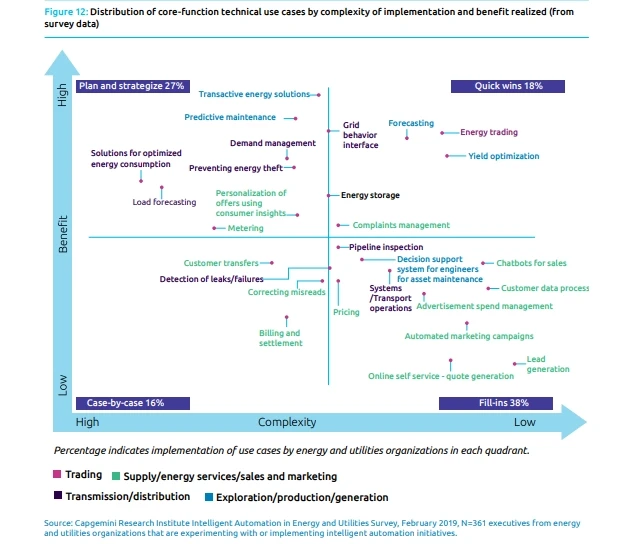
It seems that automation of some processes is key to cutting rising costs, but managers seem unable to take advantage of its potential. This is confirmed by a report prepared by Capgemini, in which almost 530 business leaders from the utilities sector presented their views on investments in automation. According to the research, 38% of organizations focus on investing in low-effort solutions in core functions that bring low benefits. Also, only 18% invest in quick wins where the effort is low but the financial results could be higher. A similar tendency is visible for improvements in support functions.
Opportunities
All opportunities are hidden in more strategic planning, defining projects that are not simple improvements but require greater effort engage more business departments.
When it comes to maintenance, the report shows that the greatest potential is noticeable for predictive maintenance technology. Metering and load forecasting can also be profitable, and may indirectly support maintenance management issues indirectly. All of those may create a smooth process. For example, smart meters may support the identification of outages thanks to predictive maintenance algorithms, and then send tasks to a field service system. The same data may be reused for creating load forecasts.
Utilities challengesUtility issues: results of poor infrastructure maintenance
Lower customer satisfaction
Aging infrastructure has an impact on client behavior and satisfaction. For example, the J.D. Power 2020 U.S. Water Utility Residential Customer Satisfaction Study shows that one quarter of Americans claim never to drink tap water. This is related to the bad smell of the water and fears about water safety. To satisfy clients, the challenge for the utilities sector is to focus on infrastructure maintenance.
According to one senior director of utility intelligence at J.D. Power, “fixing these problems requires significant focus on infrastructure, both to ensure water quality and to communicate with customers, showing them proof that infrastructure is well maintained and that the water is safe.”
Rising maintenance costs
The Bain shows that transmission and distribution infrastructure that was underinvested in for decades results in costlier maintenance. This demonstrates that cost-to-service performance correlates directly to the quality and reliability of circuits. It means that less reliable circuits are more expensive to maintain.
Ineffective asset management
Assets are the core of the power energy and utilities industry, from power stations to transformers, pipelines, electricity cables, and more. However, many companies are still dealing with the same problems that they had a few years ago. A great many organizations lack a single, comprehensive view of their assets and processes. This leads to poor performance and the inability to accssess the true cost of assets and plan their maintenance. There are also examples of companies that are still overloaded with paperwork instead of using digital records.
Opportunities
To ensure the highest return on investment from introducing digital improvements, utilities companies should seek end to end solutions. Having one system, covering maintenance task management, predictive maintenance, and analytics presenting common types of tasks sounds reasonable. Add in the possibility to use of using those features in the cloud, and the result is greater agility into the business.
In addition, clean, renewable energy is going to play an ever greater role in the near future. This will require some additional planning and maintenance, especially for highly efficient industrial photovoltaic plants as well as wind farms.
Utilities challenges: key takeaways
With so many challenges ahead, leaving the issues of infrastructure maintenance unimproved can eat up most of the potential profits from new initiatives. Postponing changes will not help in the long run, and may affect customer satisfaction and business profitability.
To avoid such problems, it’s worth introducing a single, clear long-term strategy that applies profitable technologies and allows organizations to watch their KPIs improveing year by year. This is the key to business development in an age when the environment is volatile but also very demanding.

7 min. read
Space ODA: Integrating SatCom into the Terrestrial 5G/6G Ecosystem
6 min. read
Going Hybrid and Zero-Trust: Uniting the Sector at Critical Communications World 2026
4 min. read
Building the Foundation for AI-Native Networks: How Telecom Operators Can Prepare for 6G?
7 min. read
Going Techco: AI-Native Architecture, Digital Twins, and the End of the Monolith Era at DTW Ignite 2026
8 min. read
The EU AI Act: A Practical Guide to Compliance for Business and Technology Leaders
5 min. read
Insights from Comarch Communications’ First IoT Connectivity Forum: AI, Massive SIM Rollouts, and New GSMA Standards
9 min. read
Comarch User Group 2026: Together Towards The AI-Driven Future of ConnectivitySign up for more insightful content