




Join our newsletter to receive meaningful updates, expert insights, and resources tailored to your interests. We promise to keep our communication valuable - never overwhelming.
Out with the Old: Telcos and Device Manufacturers Are Turning Increasingly to eSIM Technology for Seamless Connectivity
Around: 3 min. read
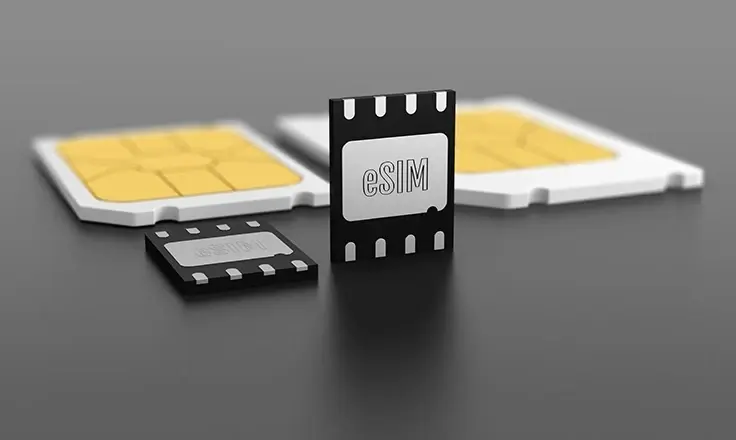
Embedded SIM (eSIM) technology is gaining traction – which is great news for telcos and their consumer and enterprise clients.
What is an eSIM card and how does it work
Also known as eUICC (embedded universal circuit card) or virtual SIM, eSIMs replace standalone SIM cards, which certainly have their limitations. For example, the physical SIMs we are all used to lock users to a particular network. If you want to change, or to have your device connected to more than one network, you need a different SIM. Then there’s the question of compatibility. Does your device take standard, micro or nano?
By embracing eSIM technology, communication service providers (CSPs) and digital service providers (DSPs) are removing these barriers.
Embedded eSIM technology
Because eSIMs are embedded in a particular device, there is no need for the physical equivalent. The device can be connected to any network (or even more than one) by installing the appropriate eSIM profile. Then, it’s just a question of buying the service bundle that you require at any time – which means, for example, that users can shop around for the best data deals while travelling and don’t have to rely on public wi-fi networks that may not be particularly secure.
Smart communications with eSIM
From the enterprise client perspective, eSIMs will open up new markets and business models for telcos. That’s because operators will be able to combine them with the network slice capabilities of 5G’s lower battery consumption, broader bandwidth and lower latency in a way that looks likely to prove far more profitable than business models in the B2C sector.
The role of eSim in telecom business
From smart cars to wearables and Industry 4.0 (and everything in between) telcos will be able to leverage eSIMs to enter the B2B/enterprise sector in many verticals. This appears to be a clear route to 5G monetization for operators, and a means to accelerate the return on their investment in physical and virtual network upgrades.
Uptake of eSIMs across the telco industry – and indeed within the Internet of Things as a whole – is already growing, with GSMA noting a doubling in the number of eSIM-ready devices in 2020. What’s more, the pace is expected to accelerate in the very near future. By 2025, we could be seeing a third of all smartphone connections in the world being made via eSIM.
That’s good news for consumers, good news for telcos, and good news for business customers.

7 min. read
Space ODA: Integrating SatCom into the Terrestrial 5G/6G Ecosystem
6 min. read
Going Hybrid and Zero-Trust: Uniting the Sector at Critical Communications World 2026
4 min. read
Building the Foundation for AI-Native Networks: How Telecom Operators Can Prepare for 6G?
7 min. read
Going Techco: AI-Native Architecture, Digital Twins, and the End of the Monolith Era at DTW Ignite 2026
8 min. read
The EU AI Act: A Practical Guide to Compliance for Business and Technology Leaders
5 min. read
Insights from Comarch Communications’ First IoT Connectivity Forum: AI, Massive SIM Rollouts, and New GSMA Standards
9 min. read
Comarch User Group 2026: Together Towards The AI-Driven Future of ConnectivitySign up for more insightful content