




Join our newsletter to receive meaningful updates, expert insights, and resources tailored to your interests. We promise to keep our communication valuable - never overwhelming.
5G Network Services: Modern Customers’ Needs and Expectations
Around: 4 min. read
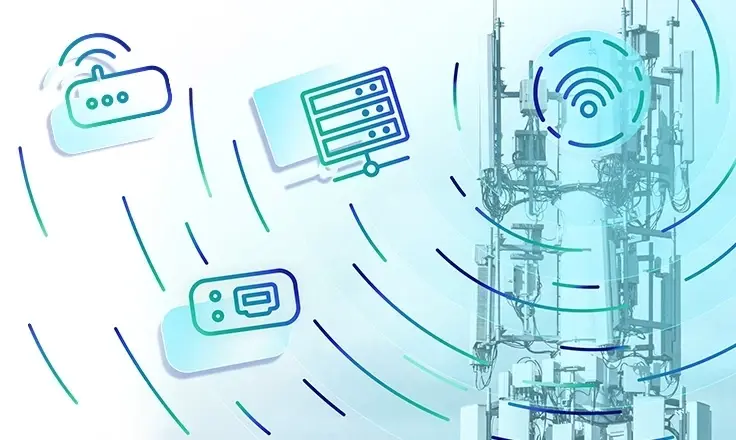
Would you like to improve 5G-based services in your telecom company? Find out what today's customers expect and what to do to best meet their needs. We reveal that taking advantage of artificial intelligence and automation is proving extremely helpful.
A quick look at the genesis of network services
Telecommunications systems began as highly centralized systems. They had large network elements (core), where all call paths converged and where operations took place to find and connect those optimal for the customer's order. Even automated systems and the first digital systems replicated this scheme. For completeness, it should be added for fairness that the persistence in this system philosophy was due to the use of legacy systems and wiring from previous systems. It was difficult to abandon, with habits and assets buried in the ground. Interestingly, wireless communications systems copied these structures at first. Large telephone exchanges (MSCs) switched transcoded signals to the standard of fixed network exchanges.
Central transcoders (TRAUs), 2 mbit/2 link controllers (DLUs), base station controllers (BSCs) managing a significant number of stations, and finally the key element, access stations. Plus the first central points of contact with data and Internet networks. And, even if small systems were built in a limited area, they would be only smaller and connected to a more central element of the operator, according to the same philosophy.
Services based on 5G networks today
Today, despite the few years since such solutions were used, they are a thing of the past. Each successive generation of wireless technology brought, first of all, decentralization of architecture. It created systems that were smaller and smaller and more and more flexible, because that's what customers wanted, mainly in industry and services. Users declared more and more personalized services and demanded more and more flexibility in creating and maintaining them. And the competitive market made it necessary to keep up with these trends.
Using solutions tested in the IT industry that now allow flexible, fast, reliable, and repeatable building of entire network topologies, moving the location of functions, including those performing different and complex tasks of core networks, and dynamically building and implementing services, we are realizing one of the promises of 5G networks. Today, we have achieved such a state of hardware technology that we have brought telecommunications systems to a state of complete decentralization. This would not have happened, of course, without a significant technological leap in hardware. Miniaturization in both industries has made it possible for us to create an autonomous system tailored for a specific customer within a larger system still managed by the CSP (communications service provider). We can deliver it to any location, run it for any length of time, and then easily shut it down or move it to a new location.
What do the customers really need?
Such architectural and technological possibilities, however, give rise to new needs among customers. They want to take full, or at least more complete, control over the configuration of what is happening in their network without waiting for days or hours for their order to be completed by an operator swamped with orders from other equally demanding customers. They want to perform the changes without involving outside human resources, to the extent and at the time they choose. In doing so, they gain self-reliance and a new level of autonomy in the network, and do not raise costs despite gaining these advantages.
The role of deep automation in addressing customer needs
Deep automation and the application of artificial intelligence allow users for whom this is not their core business to perform network and parameter reconfiguration operations simply, quickly, and reliably. It eliminates the need to have a system ready for any situation with redundant resources in favor of instant, faster reconfiguration. For these reasons, it is also cheaper; fewer resources are needed, including human resources, plus it accumulates and standardizes experience and best practices, the process of improving them being led by artificial intelligence. It also allows intensification of the CD/CI process while maintaining its stability and reliability of implementation.
Interested in improving 5G services provided by your telecom business? Read more in the white paper prepared by Comarch’s experts, entitled "Run Your Business Like an Orchestra with an AI-Powered Orchestrator". Download it to get insight into the world of AI-powered orchestration.

7 min. read
Space ODA: Integrating SatCom into the Terrestrial 5G/6G Ecosystem
6 min. read
Going Hybrid and Zero-Trust: Uniting the Sector at Critical Communications World 2026
4 min. read
Building the Foundation for AI-Native Networks: How Telecom Operators Can Prepare for 6G?
7 min. read
Going Techco: AI-Native Architecture, Digital Twins, and the End of the Monolith Era at DTW Ignite 2026
8 min. read
The EU AI Act: A Practical Guide to Compliance for Business and Technology Leaders
5 min. read
Insights from Comarch Communications’ First IoT Connectivity Forum: AI, Massive SIM Rollouts, and New GSMA Standards
9 min. read
Comarch User Group 2026: Together Towards The AI-Driven Future of ConnectivitySign up for more insightful content