Share your technical or business challenges with us. Drop a line to discuss your requirements, and we will guide you through. We will show you how our technology can be applied to your company’s individual needs.
European Tier 1 Operator
Multi-market Transformation Improves Time to Market and the Cost of Service Delivery in the Business Customer Segment.
Multi-Market Transformation Improves Time to Market and the Cost of Service Delivery in the Business Customer Segment
With the ultimate goal of improving the experience of its business customers, a European Tier 1 operator decided to undertake an ambitious multi-market transformation comprising three different markets.
The Business Need
- To shorten time to market of new services for business customers
- To address the unique requirements of each business customer, thus providing more value for this segment
- To pave the way for digital services – as the services are based on complex value chains, the operator needed to be able to smoothly incorporate partners’ products into its own product catalog
- To be able to cooperate with local and crosscountry partners
- To unify the product/service portfolio across three countries, while being able to cater to market-specific needs and to deliver customization capabilities as an option
- To perform the transformation smoothly and ensure undisrupted work of the existing systems and processes
- To have all IT systems driven by business requirements and to eliminate systems which constrain business operations
- To increase the precision of order capturing and delivery processes, while significantly reducing their cost
- To eliminate the gap between the design of the commercial solution and the technical processes required to implement it
The Approach
In order to improve offer management processes and time to market, and enable marketing and product managers to build new services quickly and easily, Comarch assumed an approach that would lead to increased service reusability and automation of product management processes.
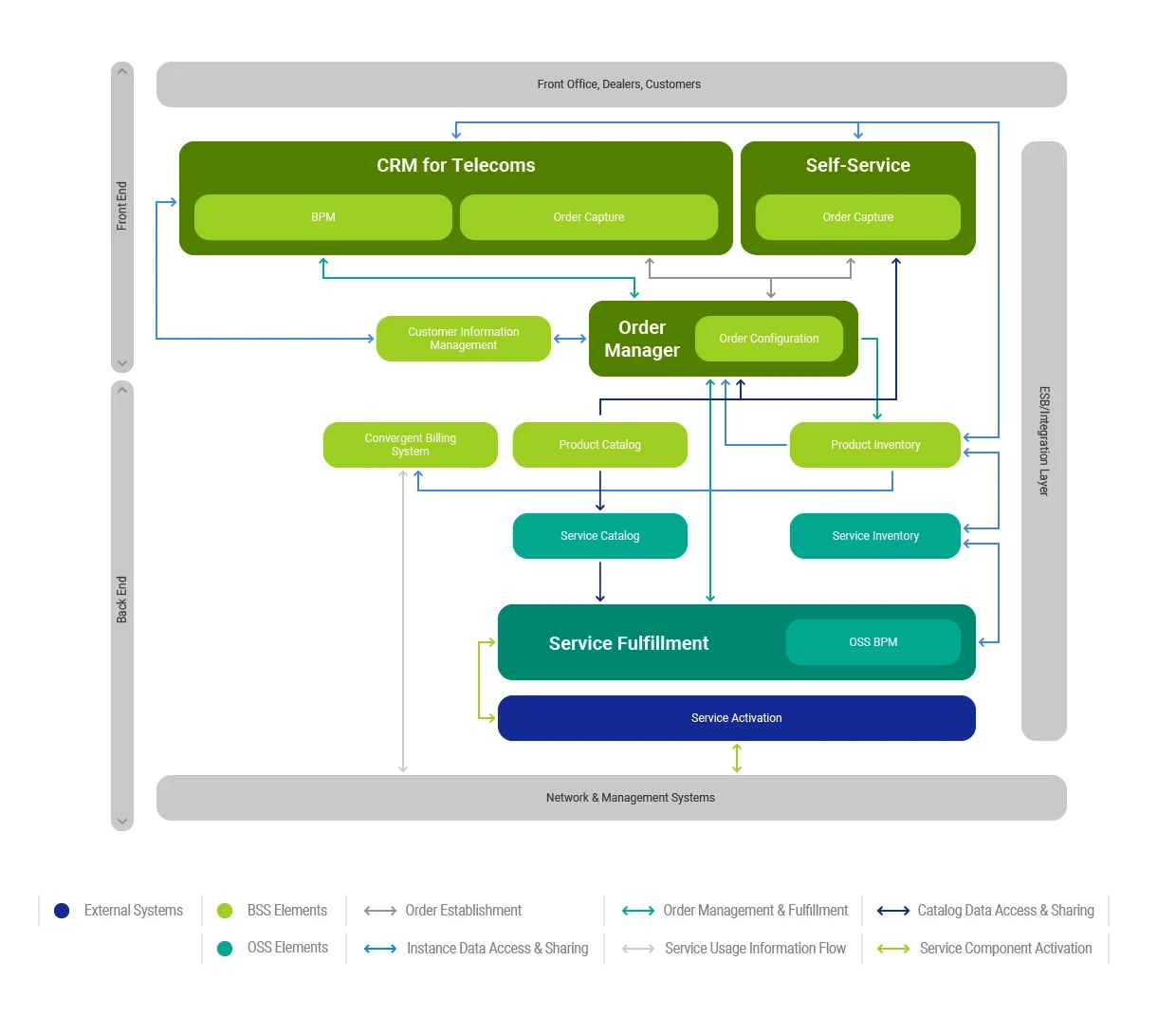
To support this approach, Comarch proposed an IT architecture built around centralized and pre-integrated product and service catalogs, placed at the heart of the BSS/OSS ecosystem. The expectation was to enable the smooth alignment of the of the offers, leading to the entire IT ecosystem being driven by the defined business needs. It will enable a fast reaction to changing market conditions by making any modifications in the existing offers more efficient (easier, faster and cheaper).
The Challenge
The challenge was to deliver new services to business customers on all of these markets faster and cheaper, while providing a market-specific and individualized offer approach, thus delivering real added value for enterprises. Additionally, as digital services delivered to enterprises are composed of elements provided by the operator and third parties, the system needed to ensure that partners’ capabilities can easily be added to the operator’s own product catalog.
To face these challenges, the operator needed to introduce a system that would best fit the requirements of the project, one that would provide the flexibility required to manage everything from one place:
- Three mature markets - system languages, system currencies, system tax regimes
- Three mature organizations with their own processes and IT architectures – operations in sophisticated, heterogeneous IT environments resulted in fragmented information
- Three different networks and local partners supporting the business
The Implemented Products
The operator was looking to introduce an umbrella BSS/OSS system serving three different markets (countries) with their own product offers for business customers.
To support the operator’s goals, the implemented system included the following functionalities:
- Product Catalog with flexible product/offer creation and lifecycle orchestration/shortening – enabling shorter time to market for new products/product bundles targeted towards business customers
- Consistent order management & service fulfillment across the entire organization
- Dedicated CRM with a single, 360° customer view giving one system for all three countries – ensuring complete information concerning business customers gathered in one place
Flexible business customer billing covers negotiable offer pricing, custom billing and split billing, and is flexible enough to allow offers to be tailored the offers to the specific needs of customers. The catalog-driven approach of the project encompassed a range of highly reusable service components that are used to automate fulfillment processes. Additional time to market savings and operational benefits are expected as a result of this.

Telekom Deutschland
Better control of network operations with transport network management & configuration, fault and performance mediation.
Orange Polska
Optimization of field service management for a network covering more than 300 000 square kilometres and more than 20 million subscribers.

Vodafone Germany
Integrated Assurance & Analytics for mobile, fixed and cable networks & services in Vodafone Germany, including Vodafone Kabel Deutschland.

A1 Telekom Austria Group
Support in entering the IoT / M2M market and becoming the leading M2M boutique provider in the CEE region thanks to Comarch Communications IoT Connect.

Bitė Group - Case Study
Rollout of OSS/BSS IT infrastructure covering major operational and business processes.
Orange Luxembourg
Comprehensive BSS stack for mobile, fixed and network services.