



Join our newsletter to receive meaningful updates, expert insights, and resources tailored to your interests. We promise to keep our communication valuable - never overwhelming.
Why OSS Becomes Critical in LEO Mega Constellations?
Around: 4 min. read
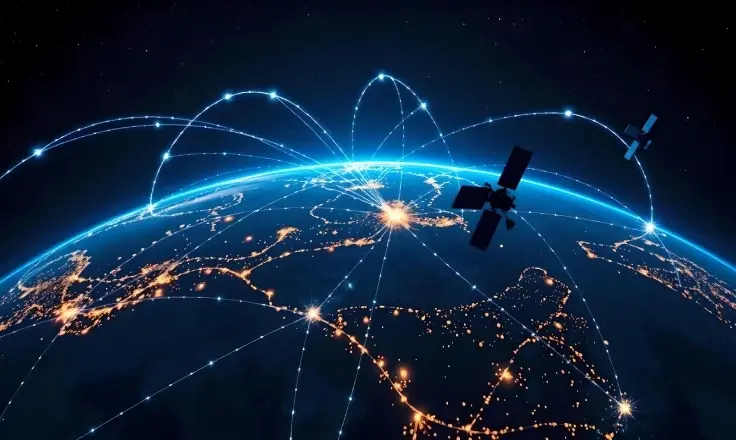
The rapid emergence of Low Earth Orbit (LEO) mega constellations marks one of the most significant transformations in the history of telecommunications infrastructure. Unlike traditional geostationary satellite systems or fixed terrestrial networks, LEO architectures introduce unprecedented levels of dynamism, scale, and operational complexity.
As satellite networks evolve into large-scale, software-driven connectivity platforms, Operational Support Systems (OSS) become not merely support tools but foundational components that ensure service reliability, commercial agility, and ecosystem integration.
From static infrastructure to dynamic networks
Traditional telecom OSS evolved around relatively stable infrastructure like fixed cell towers, predictable backhaul topologies, and long hardware lifecycles. LEO mega constellations fundamentally change this model. Satellites continuously move relative to Earth and to each other, forming a constantly shifting topology. Coverage beams, capacity allocation, and routing paths evolve in real time.
This configuration creates a network environment where topology is dynamic rather than static, service paths are recomputed continuously, and infrastructure behaves more like a distributed cloud fabric than traditional telecom hardware. In such an environment, manual operations and fragmented tooling are no longer viable. OSS becomes the system that transforms dynamic infrastructure into a manageable operational reality.
Separation between TT&C and service operations
Satellite control systems, known as Telemetry Tracking and Command (TT&C), ensure the physical health and orbital safety of satellites. However, TT&C alone cannot manage the operational complexity of modern service delivery. LEO operators must bridge two distinct domains.
- Mission control (TT&C) — maintaining spacecraft integrity and orbital coordination.
- Service operations (OSS layer) — delivering connectivity services, managing customers, and assuring end-to-end performance.
OSS becomes critical as the abstraction layer that converts satellite telemetry and network state into actionable service intelligence without interfering with mission-critical spacecraft control.
End-to-End service assurance in hybrid networks
Modern connectivity increasingly combines LEO satellite access, terrestrial fiber, mobile networks, private enterprise infrastructure, and cloud-native services. Users experience a single service, but the operational responsibility spans multiple domains and vendors. Without advanced OSS capabilities, fault isolation becomes extremely complex, SLA enforcement is difficult, and troubleshooting requires manual cross-domain correlation. OSS provides multi-domain visibility, automated correlation across satellite, ground, and terrestrial networks, and unified assurance frameworks that support hybrid NTN architectures defined by 3GPP standards.
Automation as a necessity, not an optimization
LEO megaconstellations operate at a massive scale, with thousands of satellites and millions of dynamic service endpoints. Key operational realities include frequent handovers between satellites, fluctuating regional capacity, rapid software update deployments, and continuous topology changes. Human-driven operations simply cannot keep pace with this environment. OSS enables policy-driven automation, AI-assisted anomaly detection, predictive capacity management, and automated service orchestration across moving infrastructure. In this context, OSS evolves from monitoring tools into autonomous operational platforms.
Satellites enabling new business models
LEO networks shift satellite connectivity from niche infrastructure toward mainstream global access platforms. This creates new market structures such as multi-provider aggregation, satellite connectivity resellers, hybrid terrestrial and satellite service bundles, and industry-specific connectivity solutions for aviation, maritime, energy, and defense. These models require flexible product catalogues, real-time charging and billing, multi-tenant service management, and rapid partner onboarding. OSS and BSS integration becomes the engine enabling commercialization at scale.
Sovereignty, security, and regulatory complexity
Satellite connectivity increasingly intersects with national infrastructure strategy, resilience planning, and regulatory frameworks. Operators must manage jurisdiction-aware routing, compliance monitoring, data sovereignty requirements, and security assurance across space and terrestrial domains. OSS platforms provide governance layers required to operationalize these constraints in complex hybrid networks.
The future of LEO operations
As static satellite infrastructure evolves into dynamic, software-defined global networks, OSS evolves from a supporting operational tool into a critical enabler of scalability, automation, and commercial viability. The organizations that successfully operationalize LEO and hybrid NTN environments will not be those with satellites alone, but those capable of orchestrating complexity across domains. OSS becomes the control fabric that translates orbital-scale infrastructure into reliable, monetizable, and continuously evolving connectivity services.

7 min. read
Space ODA: Integrating SatCom into the Terrestrial 5G/6G Ecosystem
6 min. read
Going Hybrid and Zero-Trust: Uniting the Sector at Critical Communications World 2026
4 min. read
Building the Foundation for AI-Native Networks: How Telecom Operators Can Prepare for 6G?
7 min. read
Going Techco: AI-Native Architecture, Digital Twins, and the End of the Monolith Era at DTW Ignite 2026
8 min. read
The EU AI Act: A Practical Guide to Compliance for Business and Technology Leaders
5 min. read
Insights from Comarch Communications’ First IoT Connectivity Forum: AI, Massive SIM Rollouts, and New GSMA Standards
9 min. read
Comarch User Group 2026: Together Towards The AI-Driven Future of ConnectivitySign up for more insightful content